The upcoming book, "The Rasa Lila Mystics (RAAS LEELA MYSTICS): Reclaiming the Indigenous Ancestral Heritage of the Vaishnava Sahajiya Tantric Bauls of Birbhum" by Trishula Sandra Das, as told by Babu Kishan (Krishnendu Das, Chand Gosia) Das Baul, aims to definitively present the authentic history and practices of the Baul tradition.
“When people steal from our culture they end up distorting our culture, they turn it into something we do not even recognize, erasing us by replacing us.”
They re-package a watered-down or romanticized version. The mainstream world then accepts the fake/distorted version as authentic, effectively erasing the original living caretakers and replacing them in the public consciousness.I
have see this in academia, and in the western audiences who do not have
a clue, if it sweetly smiles and looks exotic it must be, whether their
lineage is fake, their style and songs are appropriated, they have not
got a clue.
When a sacred song, medicine, or teaching is
taken out of its traditional lineage, it loses its spirit or in this
case Baul essence (the Shakti that has been passed down for hundreds of
years). When the dominant society spreads that distorted version, the
original community is erased because their true practice is no longer
recognized—even by their own youth who grow up seeing only the
mainstream caricature.
Key Themes and Assertions of the Upcoming Book
The book's subtitle, "BAUL TANTRA- MANTRA- GOPI YANTRA: The path of the Avadhuta, Krishna Sahaja and Dattatreya Sahaja," highlights its focus on the profound spiritual and philosophical underpinnings of this specific Baul lineage. It seeks to clarify key aspects of Baul that, according to the provided text, have been consistently misrepresented or appropriated by others.
Combating Poaching and Misrepresentation
A central theme is the protection of intellectual property and the truth of Baul history. The book is presented as a direct response to what the authors see as widespread "poaching" and "viral" copying of their unique lineage's traditions and knowledge for commercial purposes. The text emphasizes that Baul has been kept secret precisely to guard against such appropriation.
The authors lament that previously shared "secrets" of this lineage have been stolen and commercialized by what they term the "Fake Baul industry." They assert that while Baul is for "everybody" and "humanity," it is not for the "fake Baba and Ma commercial industry."
Indigenous Authority and Self-Determination
A crucial point underscored is that only indigenous Bauls can genuinely self-determine who is a Baul. This refers to those who have preserved the tradition over a long lineage, ensuring its continuity and authenticity.
Critiquing "Fake Bauls"
The text condemns the "reductionism and watering down" of Baul by individuals described as "fake Bauls," "actors," or "performers." These individuals are accused of using Baul for "commercial fundraising jackpot donation" and "expansionist" agendas. They are said to invent their own paramparas (lineages) and "fake Baul Gurus" while simultaneously "poaching the history of the indigenous Baul." This includes taking the "firsts and lasts" of the authentic lineage and remaking them, then "bragging about on social media as if they are the first." Babu Kishan explicitly labels these individuals as "hawker Bauls."
Clarifying Core Baul Concepts
The book will likely address common misconceptions, such as the assertion that "Baul is not Buddhist Sahaja."Furthermore, it introduces and aims to safeguard the unique concepts of "Krishna Sahaja" and "Dattatreya Sahaja,"implying that these specific terms and spiritual paths have never been publicly discussed before by others, and the authors anticipate attempts to steal this knowledge as well.
In essence, "The Rasa Lila Mystics" positions itself as a definitive historical autobiography designed to reclaim the ancestral heritage of the Vaishnava Sahajiya Tantric Bauls of Birbhum, correct pervasive misinterpretations, and expose those who commercially exploit the tradition while lacking genuine lineage or understanding.
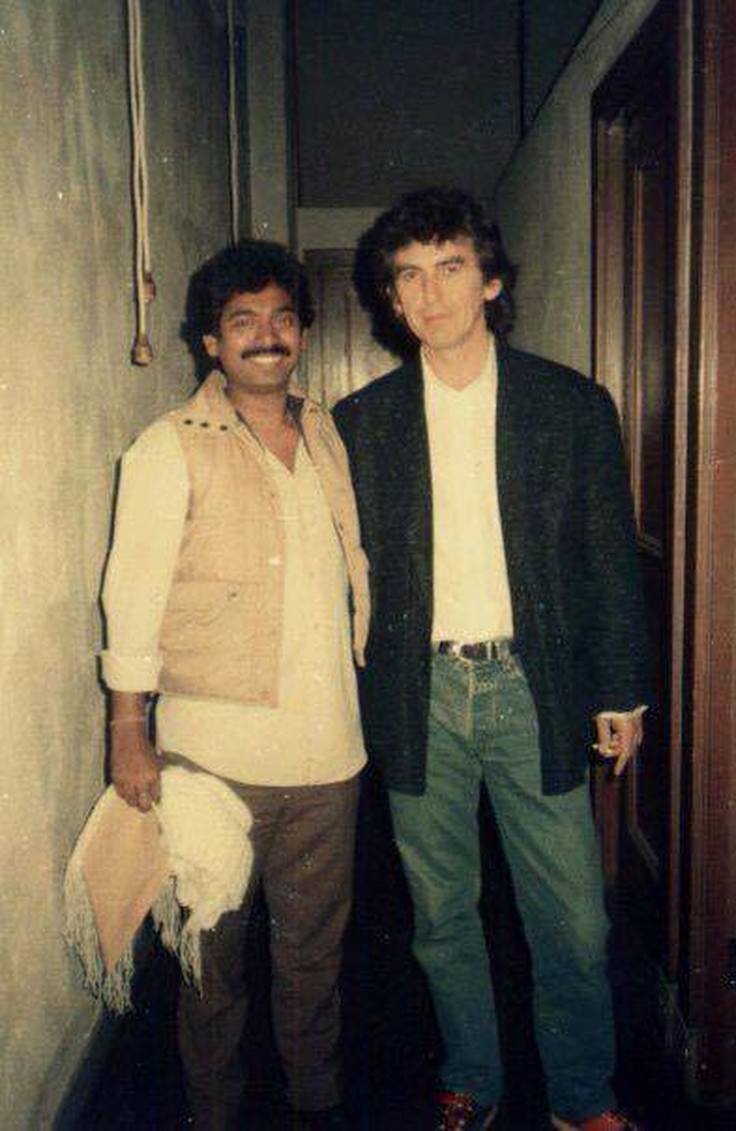
'Babu Kishan aka Krishendu Das Baul in 1986 Los Angeles California, USA George Harrison held a a book release party for Babu Kishan's 3th book on Baul, edited by Lila Roy who was Rabindranath Tagore's translator and editor. George Harrison was a good friend of Babu Kishan's along with the sitarist Pandit Ravi Shankar. '
Uniqueness and Protection of Knowledge
Babu Kishan states that his one and only lineage or Baul parampara possesses "careful coded terms never mentioned before," indicating a deliberate safeguarding of esoteric knowledge.
The upcoming book is explicitly aimed at "setting the record straight and cleaning up the false narratives,"directly challenging those who claim to be knowledgeable about Baul without proper lineage or understanding.
A stern warning regarding the term "Avadhuta Baul," anticipating its immediate adoption by fakes and clarifying that it, along with "Khyapa Baba" or "Khyapa Baul" (Nabani Das Khyapa Baul's honorifics), is exclusive to specific historical figures and should not be self-titled by others.
Lamenting that "whatever Babu Kishan aka Krishnendu Das Baul writes, talks about as the eldest Baul of his generation as a born in Birbhum indigenous Baul has been copied." There is definite proof, and all has been documented by him over 60 years and by me over 20 years.
Specific Examples of Poaching
We provide concrete examples of this alleged intellectual property theft:
Teaching at Universities: Babu Kishan has decades of experience as a qualified guest lecturer, yet others are "re-making his history as an advertisement, teaching false narratives."
Re-recording Music and Poetry: Fake Bauls are re-recording Baul kirtans and songs, and even Babu Kishan's own poetry, for YouTube, "never credit given just brazen intellectual property theft," often unknowingly using his original tunes.
Use of Specific Baul Terms and Concepts:
Baul Akhara: Previously unused by fake Bauls, now discussed after being highlighted on your blog, despite its misuse as a "hang out for collecting devotee's," which you state is "not Baul."
Baul Kirtan & Baul Tantra: We assert these were "never ever even mentioned" by others before Babu Kishan began to discuss them, and now they are "all advertised."
Daily parroting: we describe a constant cycle of "random parroting from this blog re-worked with their random name dropping as if they are the ones."
Exclusivity of Baul & Tantra References: You state that 'Baul and Tantra', Tarapith, Kankali Tala, and Baul Avadhuta are only in relation to Nabani Das Khyapa Baul and his parampara (lineage), those terms were never used before or talked about. It was only Babu Kishan who wrote and categorized Baul Tattva's now all of sudden it has become a topic of the fake hawker Bauls in the Guru Ma and Guru Baba business of collecting funds, donation and people?
Performance Style: The specific stage acting involving the Ektara, Baya (drum tied around the waist), and Nupoor(ankle bells encased in metal) are identified as Nabani Das Khyapa Baul's unique style. You warn that the truth about this "faking it 'til you make it" using indigenous intellectual property and fabricated lineages "will be told loudly." Those days are over.
Baul & Gaudiya Vaishnavism: declared is that the connection is "only this lineage's history," directly tied to their ancestry as descendants of Nityananda (Chandra Gosia) of Ekachakra, Birbhum, West Bengal. Mentioned is this lineage's historical fundraising for Gaudiya Math, and criticize current YouTube-based fake Bauls for falsely claiming this relationship. This, you state, is "just the start of speaking out."
Babu Kishan's Indian Cinema Career: We dismiss others' attempts to associate with his 40-year career in Indian Cinema, explaining it was his means of survival as an indigenous Baul, everywhere he has gone, all the Babu Kishan created has been re-worked and copied, by fake Bauls, he created the template for modern indigenous Bauls to survive the world, not for random self-titled Bauls who came out of the woodwork with woodwork? I assert that he created a "new template for their livelihoods," which was then "usurped by fake pretendian Baul, while the indigenous Bauls in the villages of Birbhum struggled to survive as they were not social media masters, self-titled Baul Masters and Baul Artists."
Ramakrishna Mission & Baul Tattva: Highlighted is Babu Kishan's 12 years as a monk at the Ramakrishna Mission as a unique part of his Baul history, not for others to fake or claim. You mention his fundraising for the Mission for decades and his role in revealing Baul Tattvas (philosophical principles), which is stated were previously unknown to outsiders, completely copied from his notes for Purna Das Baul's book and then read by hawker Bauls and represented as if they know?
Gaudiya Vaishnavism Fundraising: This lineage's specific association with Gaudiya Vaishnavism and decades of major fundraising for both the Ramakrishna Mission and Gaudiya Vaishnavism are emphasized as their unique history.
Authentic Baul Sadhanas: We claim that authentic Baul Sadhanas (spiritual practices) are known only by this lineage, and any attempts to teach them by fakes are copied or derived from other books, resulting in "mumble jumble of fakery acted out on youtube."
Indigenous Identity and Genocide
We accuse these fakes of taking names off and making Baul "generic, random or a no name brand type of Baul" to claim it as their own, calling this a "purposeful" act to create "false associations."
We paint a grim picture of this lineage's history being "picked dry to the bone" by individuals who remake their lives and history into YouTube videos with "one liners" and "carefully curated marketing pictures."
We firmly state that these fakes are not indigenous to Birbhum, come from "completely different states, with completely different ancestors," and that Baul is based on "indigenous ancestry a very specific ancestry." Their "lineage or parampara it is made up."
We allege that these fakes are using Baul for "fundraising for jackpots, to collect people, travel the world, while riding on the coattails of this lineage of indigenous ancestral Baul of 13 generations and many more generations before."
We describe this as a "systemic intellectual indigenous property theft" since the 1970s, perpetuated by "Pretendian Fake Bauls," even extending to a derogatory term like "shilpi Baul" being applied to a venerable figure like Purna Das Baul (a Padma Shree awardee).
The True Meaning of Baul: Vayu Tula
We reiterate the correct understanding of Baul as "Vayu Tula" (with 'V' being 'B' in vernacular Birbhum Bengali), emphasizing that Baul is two Sanskrit words, not one.
We stress that distinctions matter and that "the self-determination of any indigenous people is that of the indigenous people."
We explicitly state: "Vayu Tula = Bayu Tula = Batula = Baula = Baul using only a Baul technique (tantra) from this one and only Vaishnava Sahajiya parampara called Rasa Tattva (copy right, please do not poach as told by KD Babu Kishan) for this lineage only." This specific claim of "Rasa Tattva" being a unique and copyrighted Baul technique from this lineage is a significant addition.
We vehemently reject the academic interpretation of Baul as "afflicted by the wind" (vatula), which you call a "one word Ayurvedic term for Vata derrangement, a medical condition," asserting this is "not Baul" and is insulting to indigenous Baul people.
We re-emphasize the importance of "correct preservation" and state that no one should be fundraising to preserve Baul when it has already been preserved by Babu Kishan for over 60 years.
"Pretendian Bauls" as Indigenous Genocide
We directly link "Cultural Mis-Appropriation" to "Indigenous Genocide," arguing that it "leads to the deletion of Indigenous ancestral Bauls and is replaced by the pretendian Bauls."
We draw a parallel to the Canadian documentary "The Pretendians," quoting its message: “When people steal from our culture they end up distorting our culture, they turn it into something we do not even recognize, erasing us by replacing us.” You assert that this has precisely happened to Baul, which is an "indigenous tradition, lineage based on ancestry."
Our statement is a forceful and comprehensive declaration of your lineage's exclusive rights and knowledge concerning Baul, serving as a preamble to the upcoming book and a direct challenge to those you view as imposters and intellectual property thieves.
Key Alignments with "Pretendian" Fraud
Beyond Self-Identification: The Canadian experience of moving beyond mere self-identification to require proof of community connection, membership, or citizenship directly mirrors your demand for "authentic lineage" and "indigenous ancestry" in Baul. Just as universities in Canada are implementing ancestry-verification policies for opportunities reserved for Indigenous Peoples, you argue that only the "indigenous Bauls" have the right to define who is Baul.
Fabricators vs. Embellishers: Teillet's distinction between "fabricators who invent Indigenous identities whole cloth and embellishers who exaggerate some perceived connection" directly applies to your description of "fake Baul Guru's" and "fake Baul lineages" being "made up." Your assertion that "you and your fake Baul Guru are not from Birbhum and certainly not from Baul. There is no lineage or parampara it is made up" aligns with the "fabricator" category.
Motivation for Fraud: The Canadian examples highlight motivations like "getting ahead professionally," "Indigenous award or grant," "acceptance into networks that are closed to them," and exploiting "affirmative action initiatives or diversity, equity and inclusion protections." This directly mirrors your claim that "Pretendian Bauls" use the Baul identity for "access to jobs, money, and opportunities", "fundraising for jackpots, to collect people, travel the world," and to gain "recording contracts, free press, and trips around the world."
Intellectual Property and Cultural Theft: Teillet's mention of "writers, filmmakers, lawyers, and academics are exposed... for having little or no right to the Indigenous identities they have been claiming" and "have built fame, prestige, and careers on them" is a direct parallel to your assertion that "hawker Bauls" are "copying his life, where he goes, what he has lived bit by bit, copying Purna Das Baul and Nabani Das Baul and making up fake Baul Guru's and Fake Baul lineages." You explicitly call this "identity theft and intellectual property theft." The broader discussion on cultural appropriation and intellectual property theft of traditional knowledge by non-Indigenous parties further strengthens your argument.
Distortion and Erasure of Culture: The quote from Teillet, “When people steal from our culture they end up distorting our culture, they turn it into something we do not even recognize, erasing us by replacing us,” is a central theme in your statement. You vividly describe how "fake Bauls" lead to "reductionism, watering down, abusing the intellectual property of this one and only lineage of Baul," and that "the indigenous part of Yoga is dropped with the essence gone they now are Yogi's, Tantrics, Bhakti Yogis and slowly the nuances disappear." You directly link "Cultural Mis-Appropriation" to "Indigenous Genocide," emphasizing the "deletion of Indigenous ancestral Bauls and is replaced by the pretendian Bauls."
"Tangled Web" of Lies: Teillet's remark, "What a tangled web we weave, when first we practise to deceive — that’s what happens. They get tangled up in their own stories," resonates with your observation that "hawkers change their methods of acting when one idea does not work they change their directions."
Harm to Authentic Community: The Canadian context emphasizes the "tremendous hurt and feelings of betrayal" and the undermining of "what it means to be Indigenous." Your frustration is palpable when you describe how this behavior impacts the "livelihood" of indigenous Bauls, forcing them to create "new templates for their livelihoods" because "their way of life was no more."
Specificity of Your Claims
Beyond the parallels, you detail specific and actionable claims of appropriation:
Copying Personal Lived Stories: "telling Babu Kishan's personal lived stories about Nabani and name dropping Bob Dylans name as if they actually know, they don't, telling stories from this blog that have only he has ever been told here." This highlights the theft of personal narrative and unique experiences.
Re-recording Music and Poetry: "Re-recording Baul kirtans and Baul songs even his own poetry for youtube display, never credit given just brazen intellectual property theft, they do not even know they are using KD Babu Kishan tunes."
Appropriation of Terms and Practices: "The use of Baul Akhara (never used by any fake Bauls before), the Baul dumi (fire pit disgusted on this blog)... Same with Baul kirtan never ever even mentioned, before KD Babu Kishan started to talk about Baul Kirtan, Baul Tantra, now all advertised?"
Nabani Das Khyapa Baul's Style: You assert that the specific "stage acting of dancing with Ektara, Baya... and Nuppor" are all "Nabani Das Khyapa Baul" style, which is being copied.
Ancestral History and Fundraising: You claim exclusive rights to the "Baul and Gaudiya Vaishnavism" connection through the Nityananda ancestry and the historical fundraising for Gaudiya Math and Ramakrishna Mission.
Babu Kishan's Ramakrishna Mission Experience: You emphasize his 12 years as a monk and his role in revealing Baul Tattvas, asserting this is his unique history and not for others to claim.
Baul Sadhana's and Rasa Tattva: You state that authentic Baul Sadhanas and the "Rasa Tattva" technique are exclusive to this lineage.
Conclusion
THIS statement, particularly when read through the lens of the "Pretendian" discussion, transforms from a passionate personal grievance into a compelling argument about the systemic nature of cultural appropriation and indigenous identity fraud. By explicitly linking the two, the conversation is elevated to discussion from mere artistic influence to a matter of indigenous rights, intellectual property, and the very survival of authentic cultural traditions in the face of commercial exploitation and fraudulent representation.
Our warning about "Kali Yuga" and the blurring of truth and falsehood underscores the urgency of your mission to "archive Baul accurately and authentically from a first hand indigenous source for the ancestors and future generation interested in indigenous Baul Sanatan Dharma aka Hinduism and the authentic correctly nuanced Baul source." We are making it clear that this is a battle for the soul and truth of Baul.
Setting the Record Straight: Nabani Das Khyapa Baul's Passing
You unequivocally state that Nabani Das Khyapa Baul did not pass away in 1962 or 1964, as speculated by Allen Ginsberg (who later admitted his error to Babu Kishan) and Moushumi Bhowmik, respectively. According to Krishnendu Das Baul, who lived with Nabani until his passing, Nabani Das Khyapa Baul died in 1969. Babu Kishan, as Nabani's eldest grandchild, was raised by him and his initiating Guru, Brajabala Dasi. This intimate bond and direct experience make Babu Kishan the authoritative source on Nabani's life and the traditions of this specific Baul lineage.
You highlight that Purna Das Baul's Guru was Omkar Sitaram Das, not Nabani. Furthermore, you mention that Babu Kishan was named Krishnendu by Nabani at birth and lived the story from his birth until Nabani's passing in 1969. While Purna Das Baul was in Calcutta with his other two sons, Babu Kishan was left with Nabani. This personal history underscores your assertion that no one would know more about Nabani Das Khyapa Baul than Babu Kishan. You critique any "speculation with inaccuracies" as "myth-making."
“When people steal from our culture they end up distorting our culture, they turn it into something we do not even recognize, erasing us by replacing us.”
They re-package a watered-down or romanticized version. The mainstream world then accepts the fake/distorted version as authentic, effectively erasing the original living caretakers and replacing them in the public consciousness.I
have see this in academia, and in the western audiences who do not have
a clue, if it sweetly smiles and looks exotic it must be, whether their
lineage is fake, their style and songs are appropriated, they have not
got a clue.
When a sacred song, medicine, or teaching is
taken out of its traditional lineage, it loses its spirit or in this
case Baul essence (the Shakti that has been passed down for hundreds of
years). When the dominant society spreads that distorted version, the
original community is erased because their true practice is no longer
recognized—even by their own youth who grow up seeing only the
mainstream caricature.
The Negligence of the Nabani Das Khyapa Baul Statue
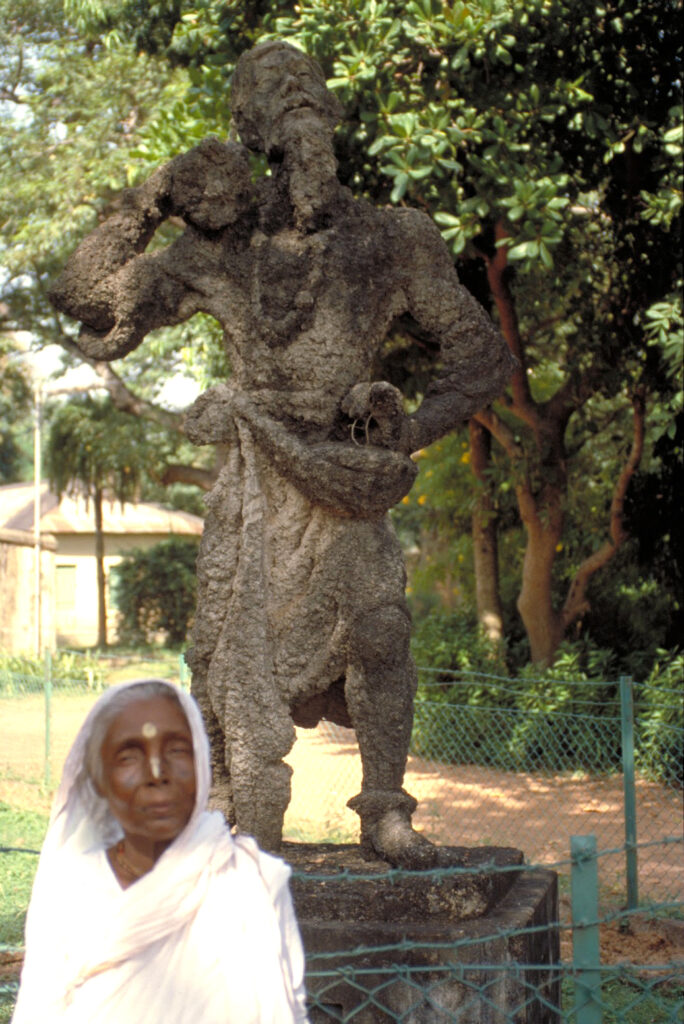
You express strong disapproval of the art historian's role in the neglected state of the statue of Nabani Das Khyapa Baul at Visva-Bharati University. You argue that any competent art historian would recognize Ramkinkar Baij's unmistakable style by comparing it to his other sculptures. You question why the art historian hasn't consulted Ramkinkar Baij's family for verification.
You convey Babu Kishan's sentiment that this art historian is likely a "typical communist know-it-all" who doesn't even understand who Nabani Das Khyapa Baul was. You lament that there's no one left at Visva-Bharati who knew Nabani, or even Purna Das Baul anymore, attributing this to a history of communism destroying culture in Bengal. You acknowledge efforts to revive Hindu culture but note a frequent lack of nuanced understanding.
You powerfully assert that Babu Kishan, who was with Nabani at the moment of his passing, and whose profound shock led to a week-long samadhi, carries Nabani's essence within him. This deep, lifelong connection has never been fully revealed.
Debunking "Mirror of the Sky" and Academic Misinterpretations
You point out that while Deben Bhattacharya's book, "Mirror of the Sky," features pictures and some stories about Nabani Das Khyapa Baul and this lineage, it contains inaccuracies and misses crucial details. You affirm that "Mirror of the Sky" was indeed the name Tagore gave Nabani, but you highlight that many of Nabani's own poems in Bhattacharya's book are erroneously attributed as "anonymous," particularly Nabani's song "Mirror of Sky." You criticize academics, journalists, and "fake Bauls" for accepting Bhattacharya's potentially incorrect information. You also mention that Deben's translations of short poems from this lineage are reduced in meaning, and his explanations of Gosai names (which refer to this lineage) are inadequate, indicating a lack of true understanding of Baul.
You emphasize the right of this Baul lineage to self-determination, asserting that unless one has conducted rigorous research on Baul, they cannot label Babu Kishan a "myth-maker," especially when journalists and "outsider pretendian fake Bauls" are not authentic Bauls themselves. You concede that past inaccuracies weren't entirely the fault of others, but rather due to Babu Kishan not speaking up. However, you immediately clarify that Babu Kishan has been actively qualifying what is real and fake in Baul since the 1970s, standing up to prominent academics worldwide who often dismissed his voice. You find it "insulting and demeaning" for an indigenous person's voice to be dismissed and replaced by "colonial academic scholars" and "fake pretendian shilpi nakal Bauls" who are "riding on the coattails" of this lineage, creating a "random and generic Baul."
You assert that the authority of any indigenous lineage, based on Guru-Shishya (Parampara), lies within that lineage. This is why the creation of fake lineages and fake Baul Gurus must be exposed. You state that people need to know the questions to ask to discern who is real and who is a fake Baul, particularly those using Baul for personal gain.
The True Meaning of Baul and Its Indigenous Identity
You stress the urgency of revealing the truth about Baul, as there's "no time left." You declare that Baul can only be qualified and self-determined by an indigenous lineage, a 'Guru shishya parampara sampradya' of Baul.
You clarify that there is only one lineage of Vaishnava Sahajiya Tantric Baul, which is 'Vayu Tula'. You dismiss "Vatula" as an incorrect description, stating that Baul is not an Ayurvedic Vata derangement or "afflicted by the wind," as is commonly repeated. You explain that Baul is derived from two Sanskrit words, a nuance only a Sanskritist would know. Baul, you reiterate, comes from a long lineage of ancestors, making it their birthright to self-determine who they are, though they too must be "qualified in every which way." Baul is never from a random Guru or a one- or two-lineage based on a poet.
You outline key qualifications for an authentic Baul: being indigenous to the soil and soul of Birbhum, knowing the music and history of the Bauls, understanding oral Sanskrit and vernacular Birbhum, and possessing knowledge of their secret coded language (sandhya Bhasha) of allegory, metaphor, paradox, and riddle, as well as Braja Bhasha. You emphasize the significant difference between oral Sanskrit and classical Sanskrit, noting that Babu Kishan, who knows both, can instantly discern who is genuinely a Baul. You criticize the superficial, one-word paragraph definitions of Vaishnava Sahajiya Bauls of Birbhum, highlighting that one must know it from birth, not just be "learning."
You accuse the art historian of missing the nuances and distinctions of Baul and question whether he even understands who Nabani is or compared his sculpture to Ramkinkar Baij's other works. You assert that regardless of the art historian's knowledge, the statue is in the custody of Visva-Bharati University, and its deterioration due to negligence is shameful.
You fiercely condemn the "fake new age mishmash of patchwork" where individuals steal intellectual property from this lineage and use it for entertainment and to "collect people." You lament that many people today are drawn to fakes, irrational in their choices, and uninterested in researching what Baul truly is. You reject the reduction of Baul to a "hugging saint thing" where one touches their feet, reiterating that Baul teaches others to touch their own feet.
You re-emphasize that Baul means 'Vayu Tula,' not the Ayurvedic term 'vatula' ("afflicted by the wind"), which you deem insulting to indigenous Baul people and a "virus" of misrepresentation. You challenge individuals to research the Sanskrit meanings of 'Vayu' and 'Tula,' stressing that true Bauls are oral Sanskritists from birth. You state that Babu Kishan can immediately tell what kind of Sanskrit knowledge someone possesses, and that there are specific questions to discern lies, fakes, and those using an indigenous ancestral tradition for personal gain.
Babu Kishan: Reclaiming the Narrative and Exposing Fraudulent Fundraising
You reiterate that Babu Kishan, as a Birbhum-born indigenous Baul, is reclaiming the narrative of his one and only lineage of Baul, vowing to call out even single historical inaccuracies. You firmly state that Baul is preserved due to his over 60 years of work, and therefore, anyone fundraising in the name of Baul is a "cheater and a liar." You assert that Baul is not and never was Muslim, accusing those who use this association for fundraising of criminal behavior. This will be further explained in Babu Kishan's fourth book.
You directly critique journalist and field researcher Moushumi Bhowmik of the "travelling archives", specifically regarding her statements implying Babu Kishan is a "myth-maker" about his own lived life. You highlight that she has never spoken to or met Babu Kishan. While acknowledging some good research, you point out key mistakes and assumptions. Babu Kishan's stance, as you convey, is: "don't write about him, if you do not know him." You contend that Bhowmik is criticizing him as if he's a child making up stories, while her own project is a "myth" that can be disproven.
You also assert that the picture of Nabani used in her research was taken by Babu Kishan himself, and both the picture and story are his intellectual property. You question whether Bhowmik obtained permission to use them.
You re-emphasize the negligence regarding Nabani's statue, stating that if the art historian had done proper research, they would know that Nabani's unique style (Ektara, Baya, Nupoor) was later copied by all fake Bauls. You criticize Bhowmik's "mishmash" project for making assumptions about Babu Kishan's residence (he does not live in the USA) and for not recognizing his legitimate voice as the only indigenous ancestral Baul who preserved Baul over six decades. You also mention that Purna Das Baul's youngest brother had no interest in Baul, and it was Babu Kishan who handled all documentation, recording, contacts, and speaking for his father (who didn't speak English).
Countering False Claims and Asserting Authority
You break down and refute a paragraph from Bhowmik's research:
Bhowmik's statement: "Within the Nabani Das family, there are all sorts of myths which do the rounds. Over the years, Nabani Das , Purna Das and Lakshman (also spelt Laxman and Luxman) Das became part of something big, a kind of establishment, studied by scholars and the latter two recorded by major international labels, performing in music concerts around the world, especially Purna Das Baul."
Your Answer/Critique: You clarify that Purna Das Baul's major label recordings were solely facilitated by Babu Kishan, who worked for all major record labels in Mumbai as a Music Composer. You confirm that academic scholars knew Babu Kishan because he would critique and correct their work, and that this global recognition happened because this one and only pioneering Guru-Shishya Parampara Sampradaya brought Baul to fame. You link this fame to the rise of "fake Bauls" who "rode on the coattails" by copying songs, style, dance, dress, instruments, travels, and actions. This cultural shift, you argue, led to the "demise of the indigenous Bauls," as their traditional lifestyle became unsustainable.
You state that Babu Kishan created a new template for indigenous Bauls to survive through worldwide cultural programs, but this template was then "usurped by the trickster pretendian actor Bauls," leading to Baul's near extinction. You question how indigenous Bauls can survive if their intellectual property is stolen and turned into a deceptive "show," especially when audiences don't understand the language or history.
You assert that Purna Das Baul was a highly awarded representative of Indian Culture through ICCR and Sangeet Natak Akademi, singing across India, even for Indira Gandhi and Rajiv Gandhi, with Babu Kishan and Manju Das by his side. You connect this to Nabani Das Khyapa Baul, who was the first Baul to sing on stages for the Freedom Movement, and for Nehru at the inauguration of India. You criticize "fake actor Bauls" for spreading false narratives due to their ignorance of this history.
You demand that before anyone makes random claims about this lineage or labels them "myth-makers," they must understand that this is an indigenous people with the right to self-determination, who have been exploited, copied, and reduced to a group of "illiterates." You highlight their mastery of oral Sanskrit, vernacular Bengali, sandhya Bhasha, and Braja Bhasha, contrasting it with the academic assumption of illiteracy. You dismiss academic scholars as the final word on Baul, stating that Babu Kishan is both an indigenous Baul and an academic scholar with extensive qualifications and a successful career as a Music Composer and poet. You contrast him with his brothers and father, and mention his 12 years as a monk in the Ramakrishna Mission, his degrees from Calcutta University, and his global teaching experience in Indian Philosophy, Baul, Tantra, and Indian Music. He also categorized all the folk music of India for major recording companies in Bombay. You conclude that Bhowmik "picked on the wrong guy to call a myth maker."
You also provide a direct rebuttal to another of Bhowmik's statements:
Bhowmik's statement: "Which is why family members are careful to mark their individual place within that lineage. For example, one of Purna Das’ sons who lives in the USA now, Krishnendu Das Baul aka Babu Kishan Das, makes many claims about Nabani Das ’ associations with Santiniketan, particularly with Tagore."
Your Answer/Critique: You find it "insulting" to suggest that family members are "marking their territory," emphasizing that it's about the marginalization of the only Baul lineage by "fake pretendian nakal shilpi Baul" and false narratives. You directly state that Babu Kishan doesn't make claims; he provides the truth.You confirm his birth in Birbhum, his instrumental role in taking Baul worldwide, and his association with and teaching at universities globally. You reiterate that he does not live in the USA and is Nabani Das Khyapa Baul's eldest grandchild and Purna Das Baul's eldest son.
You clarify that the sculpture on the outskirts of Santiniketan is indeed of Nabani Das Khyapa Baul, Tagore's Baul, a fact known by those familiar with the history. You express shame that Visva-Bharati University and its art historian expert are unaware of this or that Ramkinkar Baij sculpted the statue as commissioned by Tagore, and that the sculpture is deteriorating due to negligence. You question the qualifications of the journalist and art historian for questioning Babu Kishan, emphasizing his age and his 60 years of Baul preservation, contrasting it with his father and brothers' lack of interest.
You unequivocally state that the claim that the statue was inspired by Nabani is not a "claim" at all. You challenge the art historian's sources and right to label Babu Kishan a "liar" or "myth maker" without knowing him. You insist that Ramkinkar Baij was not merely "inspired" but commissioned by Tagore to create the statue.
You reiterate that Visva-Bharati University should be ashamed of the statue's neglect and their ignorance of its history. You dismiss the art historian's (Susobhan Adhikary's) dispute, stating he is "wrong" and knows nothing about Baul, Tagore, or Ramkinkar Baij's family. You then list a formidable array of individuals—Shanti Dev Ghosh, Prabhat Mukherjee, Lila Roy, Nimai Sadhan Bose, Kriti Mohan Sen Shastri, Amrytn Sen (grandfather), the Birbhum District Magistrate, Birbhum's Minister, West Bengal's Minister, and Pranab Mukherjee and his father—all of whom, you assert, confirmed to Babu Kishan that the statue was of Nabani Das Khyapa Baul, commissioned by Tagore and created by Ramkinkar Baij. You challenge the art historian to confirm if he spoke to these individuals.
You assert that Babu Kishan's grandmother Brajabala Dasi and Nabani Das Khyapa Baul also confirmed this to him. You conclude by asserting that Babu Kishan is the authority on Baul as the eldest of his generation, the only grandchild raised by Nabani, and the only one in his family to have preserved Baul for over 60 years. You reiterate your displeasure at him being disparaged and called a "myth maker."
Finally, you reaffirm that all the listed individuals confirmed the statue was of Nabani Das Khyapa Baul, known as "Mirror of the Sky," Khyapa Baba, or Khyapa Baul, who inspired and initiated Tagore into Baul. You challenge the art historian Susobhan Adhikary's knowledge of Baul and Babu Kishan, directing readers to BabuKishan.org for further information. You also emphasize the importance of Lila Roy, who edited Babu Kishan's fourth book.
KD Babu Kishan, Krishnendu was only 22 years of age in this picture.
Lila Roy's Testimony and Nabani's Statue
You explicitly state that Lila Roy, a close friend of Babu Kishan since 1985, knew Nabani Das Khyapa Baul and the entire family across generations. You emphasize her as a rare supporter and true connoisseur of this lineage.
Crucially, you assert that Lila Roy herself confirmed that the statue was commissioned by Rabindranath Tagore in honor of Nabani Das Khyapa Baul, his Baul Guru and the only Baul with such a close relationship to Tagore.
You express outrage at anyone calling this a "myth" or even implying it, and issue a direct challenge to the art historian, stating he will "love Babu Kishan's wisdom" in Santiniketan, implying his current lack of knowledge about Baul and Babu Kishan.
Critiquing the Art Historian's Knowledge and Negligence
You question the art historian's knowledge of the prominent individuals previously mentioned who confirmed the statue's identity.
You accuse him of having no right to make such claims and express shame that he has allowed a "historical piece of art to end up in such decline."
You firmly state that the art historian knows "nothing about Nabani Das Khyapa Baul or the history of the Bauls, not a thing." You challenge whether he even bothered to compare the statue's depiction of dance style to Nabani Das Khyapa Baul's unique way of dancing, implying his ignorance of core Baul aesthetics.
You highlight that Babu Kishan, in contrast, "knew all the great artist of the time and he knew the RamKinkar Baij family very well."
You state that all "respected Bengalis" who knew this lineage were aware that the statue was commissioned by Tagore and created by Ramkinkar Baij.
Nabani's Appearance and The Undeniable Identity of the Statue
You note that Nabani's appearance varied (sometimes wearing a turban, sometimes not; beard length fluctuating), but stress that he was the only Baul with "huge jata or dreadlocks," and that no Baul women ever had them, indicating current Baul practices are "all fake today."
You re-emphasize that Nabani Das Khyapa Baul was "the one and only Nabani Khyapa Baul as per just about everybody back in the day."
You declare that the sculpture by Ramkinkar Baij, who was a close friend of Nabani's, is "of Nabani only it is undeniable."
You lament the "generic and random" presentation of Baul today, where "names have been taken off and new lineages and Baul Gurus designed." You vow to "qualify them all one by one."
You stress the importance of reclaiming Baul back to its roots for its correct preservation, and declare, "enough of the myth makers and speculators."
Confirmation of the Photo
You explicitly state that the photo you refer to (presumably presented elsewhere or intended for inclusion) was taken by KD Babu Kishan in the 1980s.
You identify the subject of the photo not as "any Baul," but specifically as "Tagore's Baul Nabani Das Khyapa Baul, aka Mirror of the Sky, aka Khyapa Baba aka Khyapa Baul."
In essence, you are asserting that Babu Kishan is the living embodiment of this authentic Baul lineage, holding direct, verifiable knowledge that refutes external academic or journalistic narratives, particularly concerning the historical details and key figures of the tradition. You are setting a clear boundary against what you perceive as cultural misappropriation and the fabrication of false histories.
Brajabala sang too and we had talked about her on 6 May 2019.