
Official Intellectual Property & Lineage Protection Notice
Published by LineageBaul (Lineagebaul.blogspot.com)
For hundreds of years, and with escalating intensity over the past several decades, the historical achievements, "firsts and lasts," and sacred lineage (paramparā) of our family have been systematically poached, misattributed, and erased.
The pioneering, legendary work that brought the authentic Vaiṣṇava Sahajiyā Baul heritage out of the villages of Birbhum—built on selfless sevā, fundraising, and lifelong dedication—has been reduced by outsiders to a commercialized performance, a "guru business," and a circus of fabrication.
Long before modern pretenders attempted to retrace, cosplay, or claim ownership of Baul an inner indigenous Birbhuma Bengali science, the true global footprint of the 13-generation Birbhum Baul lineage was already permanently written into history.They re-package a watered-down or romanticized version. The mainstream world then accepts the fake/distorted version as authentic, effectively erasing the original living caretakers and replacing them in the public consciousness. I have see this in academia, and in the western audiences who do not have a clue, if it sweetly smiles and looks exotic it must be, whether their lineage is fake, their style and songs are appropriated, they have not got a clue.
When a sacred song, medicine, or teaching is taken out of its traditional lineage, it loses its spirit or in this case Baul essence (the Shakti that has been passed down for hundreds of years). When the dominant society spreads that distorted version, the original community is erased because their true practice is no longer recognized—even by their own youth who grow up seeing only the mainstream caricature.


Alfred George Aronowitz (1928–2005), known as the "Godfather of Rock Journalism," was a pioneering American writer and cultural bridge-builder. Long before mainstream media took youth culture and rock music seriously, Aronowitz embedded himself with the cultural icons of the 1950s and 60s, documenting history as an insider rather than an outside observer.
Key Publications & Newspapers
Aronowitz wrote for major mainstream publications during the mid-20th century before moving to independent publishing:
The New York Post: He served as a pop music and culture columnist (notably writing the influential "Pop Scene" column in the late 1960s and early 1970s). In 1959, he authored a groundbreaking 12-part series on the Beat Generation for the Post, which helped legitimizefigures like Jack Kerouac and Allen Ginsberg in mainstream print.
The Saturday Evening Post: Contributed extensive feature stories and profiles on emerging musical and literary figures in the 1960s.
Life, Look, and Village Voice: Published freelance features and commentary covering the counterculture.
Crucial Cultural MomentsIntroducing Bob Dylan to The Beatles (August 28, 1964): Aronowitz famously arranged and hosted the historical meeting between Bob Dylan and The Beatles at the Delmonico Hotel in New York City. During this meeting, he also introduced the Beatles to marijuana, a cultural crossover moment that significantly influenced the band's musical evolution toward more complex, psychedelic songwriting.
Connecting Beat Poets & Rockers: He acted as a central hub for the 1960s counterculture, introducing Allen Ginsberg to Bob Dylan and managing the Velvet Underground during their earliest days (booking their first formal gig in 1965).
"The Blacklisted Journalist"
By the early 1970s, personal struggles, drug addiction, disputes with editors, and a contentious fallout with mainstream publishers left Aronowitz outside traditional media channels.
Adopting the moniker "The Blacklisted Journalist," he circumvented the traditional publishing industry. He self-published his memoirs and collections (including The Blacklisted Masterpieces of Al Aronowitz) and later launched his online site (blacklistedjournalist.com) to preserve his extensive firsthand archives, essays, and accounts of the 1960s rock revolution.
The Ralph J. Gleason Connection: In August 1967, right around the time Rolling Stone was being founded, Aronowitz was regularly corresponding with Ralph J. Gleason, the legendary San Francisco music critic who co-founded Rolling Stone with Jann Wenner.
Contributions to Rolling Stone: Aronowitz contributed freelance pieces and interviews to Rolling Stone in the late 1960s and early 1970s—including a famous August 1968 piece on Levon Helm and The Band.
However, because Aronowitz was a "street journalist" who preferred total creative independence—and eventually managed artists, which created conflicts of interest with mainstream publishers—he clashed with editors and never stayed on a rigid staff contract at Rolling Stone.
Complete List of Publications & Newspapers He Wrote For
Throughout his career in the 1950s, 60s, and 70s, Aronowitz published work across major American newspapers, national magazines, and music outlets:
Major Newspapers:
The New York Post – His primary home for years, where he ran the "Pop Scene" column. He was famously fired in 1972 over conflict-of-interest disputes regarding his artist management work, which pushed him into self-publishing as "The Blacklisted Journalist."
The New York Sunday News – Contributed pop culture features and profiles.
The Daily Compass – An early career post-WWII progressive New York daily paper where he got his start.
National Magazines & Rock Journals:
Rolling Stone – Freelance contributor.
The Saturday Evening Post – Where he published high-profile, multi-part features on the Beat Poets (Kerouac, Ginsberg) and emerging 1960s icons.
Life Magazine – Contributed major features on youth culture and the 1960s music explosion.
Look Magazine – Published early cultural commentary.
The Village Voice – Documented the Greenwich Village folk, jazz, and literary scene.
Circus Magazine – Contributed music journalism during the 1970s.
Sing Out! & ASCAP Today – Special interest folk and music industry publications.
He started out phoning me repeatedly a number of years ago. He wanted to come to the U.S. to connect with American musicians. He told me he has become a success in India writing music for a number of the films being ground out assembly "line-style in Bollywood, which is what India calls the capital of its thriving film industry. India's Bollywood, in fact, now rivals America's Hollywood in selling movie tickets. With its name obviously meant as a take-off of America's original movie capital, Bollywood, is located in India's teeming Bombay, now renamed Mumbai for local political reasons of which I am currently ignorant.
Babu's Indian music is not like Ravi Shankar's sitar music. Babu is a Baul, a product of the famous Bengali Bauls, of which his grandfather, Nabani Das Baul, was the patriarch and of which his father, Purna, is currently the celebrated leader. The Bengali Bauls represent not a religion or a sect or a tribe but a way of life grown from performing in the streets. In other words, Baul music is one of India's folk musics. Fusing it with a combination of America's myriad musical genres is an interesting concept. Not a bad idea at all! In fact, the idea is so good, it started rekindling dreams of musical entrepreneurship in my battered brain.
Babu starts out by phoning me a lot. I tell him to buy a computer and email me, because that'll be cheaper. He does just that and starts filling my inbox regularly. But, before we do anything else, he wants me to write a story about him for my website. He sends lots and lots of photos of himself. Every day. I get another email from Babu full of information about himself and about the Bauls. Soon, he sweet talks a web-tekki named Mary into setting up a Babukishan website for him.
But when I finally go to his website to look it over, I get this message: "BROKEN HEART--SITE CLOSED." Turns out that Mary and Babu had a spat and she closed down Babu's website. Next thing you know, Mary thinks it over and recognizes Babu is just following the Baul way of life, which is Casual with a capital C. Next thing you know, Mary fills my inbox with 24 messages containing all the material that had been on the website she erased. Eventually, Babu tells me she now calls herself Mary Das Baul.
Now, I am confronted with a massive overdose of Babu's information. This comes at a time when I am not only overwhelmed by my never-ending duties as editor and one-man staff of THE BLACKLISTED JOURNALIST, an e-zine that requires a new issue on the Internet every month, but I also have begun the exciting and time-consuming task of publishing THE BEST OF THE BLACKLISTED JOURNALIST in a series of paperback books. I find myself paralyzed by indecision. Do I really have time to turn my attention to Babu? Then I get this email:
Subject: hi al,i am in newyork...babu
Date: Fri, 26 Sep 2003 08:27:45 -0700 (PDT)
From: babukishan das babukishan@yahoo.com
To: info@blacklistedjournalist.com
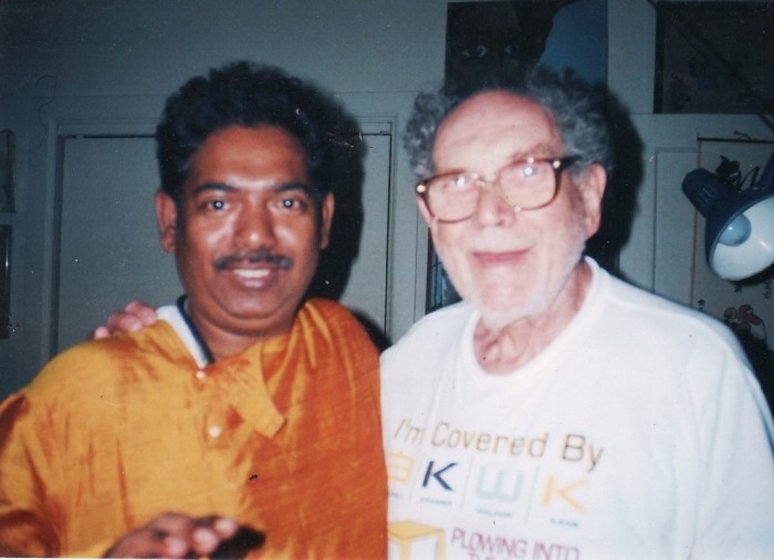
Krishnendu Das Baul (Babu Kishan) called Babooo by Allen Ginsberg and Al Aronowitz! Babooo and Al Aronowitz.
New York and Babu Kishan (Krishnendu Das Baul) are history, he went to New York every year for half a 1980s through to 9/11 2001 that changed everything. Regarding Baul and New York that Baul history belongs to KD Babu Kishan. Even if Cosplayer self-titled Baul Masters who are tracking Babu Kishan have tracked him here too, advertising that they are the ones, first you have to be a Baul.
He brings me a cassette of his hit, Soulmate, on MIL MUSIC INDIA, which Babu tells me is topping India's music charts. We play it and I find it lilting, delightful and endearing. Again, Babu tells me he wants me to write a story about him like the one I wrote about his father 18 years ago. I tell him I will when I get around to it.
That evening, my son drives Babu to my old friend David Amram's farm in Westchester. David is a famous master musician, who conducts symphony orchestras, leads a jazz group, is a French horn virtuoso, plays almost every other musical instrument known to man and delights audiences by accompanying himself while singing rap songs he improvises on the spot---something akin to the spontaneous bop prosody of his one-time buddy, Beat Generation saint Jack Kerouac. Before leaving my place, Babu says he will be back to see me in a day or two. When I ask Joel Roi what happened when Babu and Amram jammed together that night, he gives me an answer in one word: "Magic."
Dammit! And I couldn't be there! I had to stay chained to my computer. I had an issue of THE BLACKISTED JOURNALIST to get on the web. Or was I being pressed to get VOLUME FOUR OF THE BEST OF THE BLACKLISTED JOURNALIST ready for 1st Books Library, the print-on-demand press in Indiana? There are too many things happening at once.
In the meantime, I am in contact with Sally Grossman, the person who, after being alerted to them by Allen Ginsberg, discovered the Bengali Bauls during her trips to India years ago. She is also the one who brought the Bauls to the attention of Bob Dylan and, in addition, she is is the inheritor of the Bearsville estate of her late husband, music magnate Albert Grossman, the entrepreneur who managed Dylan's rise to prominence. Sally graciously offers her Bearsville Studio as a place to record Babu's fusion music---on condition that David Amram is in charge of the production."
But Babu never returns to my place. Instead, he goes off touring the country with his father's troupe to new adventures and new friends. Eventually, I send Babu an email saying:
And eventually I get an email from Babu:
Subject: i am glad to know ....babu
Date: Fri, 14 Nov 2003 11:08:56 -0800 (PST)From: babukishan das babukishan@yahoo.com
To: al aronowitz info@blacklistedjournalist.com
Well, for a long time I don't hear from Babu but that's the Baul way. Casual. In fact, that's my way, too, so I understand. In something apparently written by Sir John Wodroffe, an English scholar, I read:
Well, I tell myself, doesn't that just about describe me, too? But there's more:
Bauls have nothing..no scripture, not even to burn, no church, no temple, no mosque..Nothing whatsoever. A Baul is a man always on the road. He has no house, no abode. God is his only abode and the whole sky is his shelter. He possesses nothing except a poor man's quilt, a small hand-made one-stringed instrument called "ektara? and a small drum, a kettle drum called "baaya." That's all that he possesses---a musical instrument and a drum. He plays with one hand on the ektara and he goes on beating the drum with the other. The drum hangs by the side of his body and he dances. That is all of his religion. Dance is his religion, singing is his worship. He does not even use the word "God."
That's because the Bauls don't believe in an external God? a God in Heaven or in the trees or in nature or in anyplace outsides of themselves, The Bauls believe in a God within themselves. To
to any kind of church
to worship
. . on the waves of song and on the dancing, he moves within wards. He goes on moving like a beggar, singing songs. He has nothing to preach. His whole preaching is his poetry. And his poetry is also not ordinary poetry. He's not consciously a poet. He sings because his heart is singing. Poetry follows him like a shadow. . .He lives his poetry. That's his passion and his very life. His dance is almost insane. He has never been trained to dance. He even doesn't know anything about the art of dancing. He dances like a madman, like whirlwind. And he lives very spontaneously.
Well, I think, if that explains Babu, that also explains me. Except, I don't play an instrument. I used to be a pretty good dancer, though. And, like Babu, I do things when I can get around to doing them. And I'll go so far as to join the Bauls in saying, as one writer has quoted them:
We are the bird people---we do not know how to walk, we like to fly."
In my rekindled dream of musical entrepreneurship, I want to rope him into recording the magic he made with David Amram the night I wasn't there.
I even contacted Garth Hudson, The Band's former keyboardist, with whom I helped produce The Bengali Bauls at Big Pink many years ago. But Garth is touring. David Amram is also preparing to tour. He's going on the road with Jack Kerouac's 'sacred scroll," Jack's manuscript of On The Road. As for Hayes Greenfield, he's otherwise busy. And Julian Fenton is still in London. Sally Grossman isn't even around. She's avoiding the winter cold in Palm Springs.
So, Babu spends a night jamming with Joel Roi and one of Joel's musician friends. Joel has invented a device that enables him to stroll and play his keyboard while it's strapped around his neck like a guitar and the next night, he brings Babu to my cramped apartment. Here, Babu delivers the promised kurta punjabi to me. Equipped with a dupki, which is something like a tambourine, and also with a bracelet that he calls a ghoonghoor, Babu begins to jam with Joel in my cramped apartment. They get a riff going, with Babu hitting the dupki and shaking the ghoonghoor with hypnotizing percussion.
Before long, Babu starts singing in Hindi and then starts dancing in my cramped place. There's room only for Joel to sit while I'm perched on the edge of my cot. I can't understand a word of what Babu's singing, but he's sizzling. I find myself spellbound by the gracefulness of his dancing and the passion in his voice. Once again, my dreams of musical entrepreneurship start burning and I?m compelled to imagine girls singing a background refrain in English. Enraptured by the show Babu is putting on, I find myself compelled to rise up on my frail legs and start to dance with Babu. But there's room enough only for me to take a few awkward steps.
Footnote:
Babu loved Al Aronowtiz as a Baul loves purely, and in that love there is a deep innocence, he was so sad Al passed away in 2005. He still misses him today.
.Alfred Gilbert Aronowitz (May 20, 1928 – August 1, 2005) was an American rock journalist best known for introducing Bob Dylan and The Beatles in 1964.
The below are only exclusive to this one and only singular Baul Parampara or lineage, all the terms and associations, for too long Baul has been mis-appropriated by inauthentic opportunistic fake Bauls and written about with false narratives by the Colonial Academic scholarly institutions.


 sm
sm
COLUMN
102,
FEBRUARY 1, 2004
(Copyright © 2004 The Blacklisted Journalist)
RETROPOP SCENE:
THE BENGALI BAULS AT BIG PINK
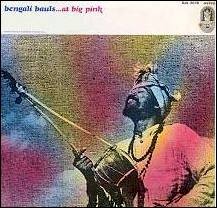
THE ALBUM COVER
[The following was originally written as liner notes for a record album called The Bengali Bauls at Big Pink, released on the Buddah label. Garth Hudson was the producer.]

The Bengali Bauls?
They are a street group from the dusty ruts of Calcutta, where you can drive 70 miles out of town and find yourself in posted Tiger country. Of course you've heard of Ravi Shankar but what the Bengali Bauls play is India's soul music. You really have to have crawled through the black muddy bottom of the earth to become a Baul. On the other hand you really have to be exalted.
They have been living in an apartment over a converted barn down the road from Albert Grossman's house for three months now, laughing and rollicking like a bunch of otters on a slippery riverbank. The word Baul itself means madcap, handed down through the ages like a fool's scepter, defying injunctions, canons, customs and rules, carried from town to town through northern India like a virus of joy while the local gentry slams its shutters, trying to keep out the infection. Like wild jokers, they can fit into any company, dancing as they walk with nods of yes to everything. It was Allen Ginsberg who first told Albert Grossman about them, with rumors of a street choir that curled as it sang, like a group of angels on a Christmas card. Those impish twinkles in their eyes? It's as if they know something groovy that you'd like to know and if you'd just let them burst into a song, you might find out what it is.
At the barn, everyone has come around to meet them. Bob Dylan, practicing each afternoon with The Band in the cellar of Big Pink, drives over for a visit from his house on a nearby mountainside and poses with the brothers Purna and Luxman Das in a Polaroid snapshot that is later seen by millions on the cover of John Wesley Harding.
Purna sings lead. Luxman plays the khrmack, which is like an inverted bongo drum with two gut strings attached from the inside of the hide to the membrane on a small cup. You put the bongo drum under your arm, pull on the cup and pluck the strings with a khrmack pick. There's also Hare Krishna Das, who plays the dotara, a stringed instrument resembling a cross between a mandolin and a banjo, and Sudhananda Das and Jiban Das, who play the harmonium and the tabla, respectively. All Bauls, of course, are brothers, although only Purna and Luxman, who lead the group, come from the same father.
In their guest cottage, they oil their bodies every morning, sleep each afternoon and cook for themselves. Indians have their own style of kosher. As den mother, Albert's wife, Sally, goes around telling her friends about this strange brood of house guests, with black shiny hair down to their waists and erupting smiles of spiritual bliss. To explain them, she gets a book by Rabindranath Tagore, the poet, scholar, and Nobel Prize winner, who was a friend of Nabani Das, the father of Purna and Luxman:
"What need, say they, have we of other temples? Is not this body of ours the temple where the Supreme Being has His abode?"
The Bauls cut across the lines that divide Hindu from Moslem and invite all the lowly to join them. Are the Bauls a religion? The street is their place of worship. God is their Man of the Heart. If others look down on them, why, then, as Tagore says, "Truth cannot be communicated to those on whom you look down. You must be able to see the divine light that shines within them, for it is your own lack of vision that makes all seem dark."
They have played the Fillmore in San Francisco and Town Hall in New York and they have recorded an album for Elektra. At Town Hall, they were on the same bill with Paul Butterfield who had invited them to play at the concert. At the Fillmore, they appeared on the same bill with the Byrds after being whisked, practically, from the airport to the stage, arriving from Calcutta just in time for the date, exploding off the jetliner in the brilliant flaming orange of their dhotis. Bauls deliberately wear the garments of both the Hindus and the Moslems, no small provocation in a country where insanity is called "the wind disease".
Only a few years ago, India looked at the Bauls like punchlines walking around in search of a joke. Now their music is considered a national treasure. In his scrap book Purna carries photographs of the Bauls in Leningrad, where they had performed as part of a proud cultural exchange. He also has pictures of himself with Indira Gandhi. He sits on the platform with her now when she goes campaigning through his territory. It was a friend who had brought the Bauls to visit Albert and Sally in their suite in the Grand Hotel in Calcutta.
When they piled into his room, it was with their instruments and a retinue. Albert ordered food. Purna sang. In his head, Albert started making arrangements for them to come to this country.
After their debut at the Fillmore, the Bauls discovered America by driving cross-country with Tom Donovan, a one-time Honolulu night club owner who had appointed himself road manager and interpreter of the group in San Francisco, translating in pidgin English that the Bauls themselves hardly understood. The Bauls are thigh-slappers. Make them laugh hard enough, and they'll even slap yours.
When they can't find the right word to explain something, they'll touch you, and you'll know it doesn't matter anyhow. Driving cross-country, Donovan had to listen all the way to choruses of the Bengali equivalent of "Wow! Look at that!" In New York, the Bauls mooned out over the
Even
in Woodstock, N.Y.,
the
Bauls still get uptight
about
tigers in the woods
bridges along the Harlem River Drive. When they got to Woodstock, they couldn't believe you could have that much forest without any houses and not have tigers, too. Now it is December of 1967 and when Sally takes them for a drive, they still get uptight about tigers. Sally, they call "sister" now. Albert is a "brother-of-the-heart." But after three months they want to get it on. The Band invites them to visit Big Pink. Tommy Donovan drives them over.
Big Pink sits atop a mountainscape in Saugerties, outside Woodstock. The Band rents it at $125 a month, a house that you'd more likely expect to find in development row on some horseshoe street in suburbia. Upstairs, the furnishings include a knick-knack shelf. But downstairs is The Band's equipment, with enough electronics to raise a baby satellite.
When the Bauls come over, they look at the pictures on the walls, drink cognac and generally loosen up. Imagine, if you can, a group of wind-afflicted Indians sliding down banisters in a house that doesn't have any. They get hung up in some bubbling water and dancing lights in a beer display that's been taken from one of the local gin mills and posted over the mantelpiece. When they play The Band at checkers, naturally they lose. They begin to argue among themselves. About what? Who knows? Hare Krishna Das turns out to be the life of the party.
"What's your name?" someone asks him.
"Hare Krishna," he says.
"The Hare Krishna?"
With a little research, The Band learns that Hare Krishna is as common a name in India as John Smith is here. They exchange addresses and telephone numbers. Finally, they take the cushions off the sofa in the living room and bring them down the cellar so they can sit comfortably on the floor. When they perform, it's cross-legged. At first, The Band joins in. Charles Lloyd, visiting with his saxophone, is also there. But The Band isn't interested in raga rock and neither are the Bauls. Nobody seems to know what's going on, so The Band gets up and lets the Bauls play.
Garth Hudson, The Band's organist and technician, turns on the tape recorder, a simple stereo Ampex that pianist Richard Manuel had picked up somewhere for $140. Garth twists and turns the dials to get the right levels. Meanwhile, the Bauls warm up in steps of talent. While the recording gets better, so do the Bauls.
According to an unwritten law, the worst singer of the group goes first and the best sings last. Everyone seems to know his turn without being told.
"There's nothing really to say," remembers The Band's guitarist, Robbie Robertson, listening to the tapes months afterwards, "except that it really did happen that way. They were playing for themselves, they weren't playing for us."
Sudhananda Das sings first, two long solos:
"Alone, I have caught a fish. The fish akes Hari's name..."
And then: "Praise my beautiful birth land... For you the world cries, but who will the world cling to while crying?"
Luxman is second: "With what flower shall I worship your feet"... The flower that blooms in the name of Hari and the flower that blooms in my tears..."
Hare Krishna is the third singer, and by now everything's cooking.
"My boatman friend off the ferry crossing... When you are the boatman, my friend of the poor, will my day go wasted like this?"
At long last, it's Purna's turn, Purna, the greatest of India's Bauls, who has walked since childhood across his country's tear-stained face at the heels of his father, Nabani, learning 5,000 songs of the soul, with each one now at the tip of his tongue.
"Say Hari, mynah bird," he sings. "...I give you gold, I give you silver, you can't deceive me... Nobody else cries my tears, your days are numbered so say Hari, mynah bird..."
He tosses his head, his voice reaches up toward heaven.
At the end you can hear bass guitarist Rick Danko and drummer Levon Helm joining the rest of The Band in respectful admiration:
"Nice!" they say.
This tape was stored away with all the other Big Pink tapes like home movies and snapshots for a family album never mounted. Some tapes of The Band and Dylan that were made at Big Pink were stolen or copied to be bootlegged on the Black Market. Probably the Baul tape would have been forgotten except for Tommy Donovan, who demanded a copy for himself.
After the Bauls went back to Calcutta, Donovan sent the tape to a studio to be processed for the stereo deck of his convertible. Afterwards, he would ride through downtown Woodstock with the top down and the volume at full-blast, a full-fledged believer in a four-wheeled hi-fi. Of course, he played it loud enough to someone else to hear it, or this album never would have come out. Stereo? Garth considers the tape to be as good as any field recording, but listen to the tabla, which sounds like huge bubbles coming up through a deep pool of bass. Listen to the presence and the separation as the Bauls dance out of your speakers and you will hear why this record can become a classic just for sound freaks alone.
The Bengali Bauls?
"The waves of love river are heavy," they sing. "How will I ride on it? Your crazy servant of God waits for you on this side of the river..." ##
This is a raw account by Al Aronowitz who really does not know who the Baul are, he is going off what he presumes them to be. No one at this time actually know who or what the Bauls were, just bits and pieces from here and there, mere speculations. This is the only Baul history of Baul in the West. Those that followed them, even today are shadow footprinting this lineage, Baul Master or today commerical donation based pretend Baul is not Baul. Sorry no they are not Baul, they are not even from the soil of Birbhum let alone Baul, today what you see and if one more person asks me NO she he is not a Baul, they are fake riding on the coattails of this lineage.


SECTION SIX
sm
COLUMN
NINETY-FIVE, AUGUST 1, 2002
(Copyright © 2002 The Blacklisted Journalist)
RETROPOP
SCENE:
THE BENGALI BAULS WOW ME IN BROOKLYN, U.S.A.
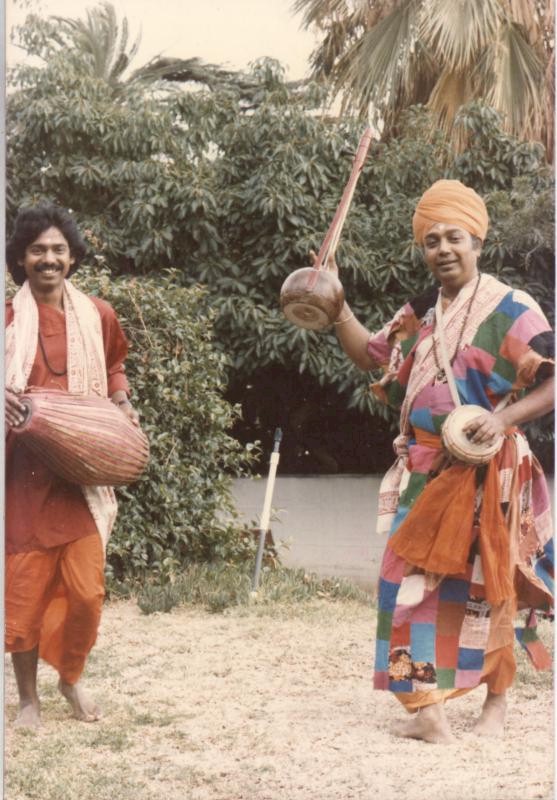
BABUKISHAN AND PURNA DAS IN TRADITIONAL GARB
ON HOME SOIL WITH TRADITIONAL MUSICAL INSTRUMENTS
NEW YORK
It's Sunday, December 1, 1985. Babukishan Das, Purna Das' 23-year-old son and rhythm drummer comes to scout me out. I call him Babu. Babu is also his father's interpreter. Purna only knows a couple words of English. Babu knows at least a couple dozen.
"At 4 o'clock, I will come back with my father and we will take you to our concert," Babu says.
How do you like that for service? These guys aint too heavy on the English but we communicate with ESP. For instance, it gets to be past 4 that p.m. I never notice. My mind's a million light years away. I'm writing, working on a story, with Sheilah E's In the Glamorous Life album blasting out of the hi-fi. But I mean BLASTING.
Suddenly, at 4:55 p.m., I realize I'll never hear the buzzer on the intercom from the concierge's desk, 33 floors below. I shut off the hi-fi, go to the house phone and ring down to the desk.
"Did you buzz for me?" I ask.
Victor's on duty.
"No," he says.
"Uhhh, wait a minute," he says. "There's someone to see you now."
Babu gets on the house phone. He doesn't have to say a word.
"I'll come right down," I say.
Purna is
waiting on the ground floor with Babu. Babu's
in jeans, but Purna's all decked out in his safron haal, including a
white dhuti, which is a skirt that gets tucked between the legs at the
calves. Purna is one of the
greatest singers in India. Purna
Das Baul, one of the Bengali Bauls, who describe themselves as men of God but
who follow what is more a tradition than a religion.
The tradition has had the Bauls dancing through West Bengali cities like
Calcutta for a thousand years, singing songs that tell people to love, to follow
the examples of Indian deities Radah and Krisna, to learn from the philosophy of
the Baul folk tales and to know just who the Bauls are.
Except 59-year-old Purna has
become too famous to work the streets any more. Tonight, in fact, he's friendly and warm but still reserved
and formal. Well, maybe it's just
the language barrier. I'm no longer
nimble enough to hop right over that fence.
ESP works better.
Outside in the chilly rain a van is waiting in the circular driveway in front of this fancy building I'm staying in. Nobody's fazed by the far-out Indian getups in my building. The place is loaded with UN, including an ambassador or two. At the wheel of the van is a Bengali-speaking American who calls himself Beasakhi. One of Purna's students, Beasakhi has set up the concert, which is being held in the Brooklyn temple of Swami Bhakdivadanta's Krisna Consciousness movement. Beasahki is secretary of the Brooklyn temple.
Also in the van is Manju, Purna's 45-year-old wife, dressed in a gray sari. She immediately shows her great charm by trying to hop over the language barrier like it was a tennis net, but I blow the serve. I’m no help. I’m up tight. Manju sings with the band. She's the lady vocalist. After the gig gets under way, she sings the first six numbers, and she sings them great.
I can hardly remember meeting Purna, back in 1967, when the Bauls spent some months at Albert and Sally Grossman's house in Woodstock, ending up on the cover of Bob Dylan's John Wesley Harding album. Sally was instrumental in getting the Bauls to dance over to the States
Purna
Das
is much more
than a one-man band
after having stayed at Purna's houses in Calcutta and in the Shantiniketan countryside for eight months. Sally'd gotten turned onto the Bauls by Allen Ginsberg, who'd started spreading international Baul consciouness after meeting Purna's father, Nabani Das Baul, the master Baul teacher, in Calcutta in 1963. The two of them liked to smoke pot together. I got into the act when Garth Hudson of the Band played me a tape the Bauls had recorded at Big Pink. I talked Garth into producing the tape as an album, The Bengali Bauls At Big Pink, selling it to Buddah with myself as associate producer. I also wrote the liner notes. The album's a collector's item now. That's how I got into the act.
Purna and his family'd arrived in the States this trip on September 23 to tour with world-renown sitarists Ravi Shankar and Aly Akbar Khan in an Indian music festival that'd camped in L.A., San Francisco, Philadelphia, Boston, Washington, Chicago and New York. It was Allen Ginsberg who'd reminded Purna to look me up when he got to New York. The first time Purna phones me, he stands me up. That's OK. The language barrier. Finally we zero in on each other. First Babu scouts me and then they pick me up and take me to the gig.
At the Krisna Consciousness Temple, I can't smoke a cigarette, but the place reeks with incense from the Govinda Boutique on the street floor. The Brooklyn Temple is a palace compared to the dives Swami Bhakdivadanta used to rent on New York's lower East Side when he first came over from India to start spreading Krisna Consciousness in the U.S. Like in a mosque, you take your shoes off. The Swami's devotees are the people who march through New York wearing safron robes, shaved heads, painted faces and percussion instruments chanting, "Hare Krisna, Hare Krisna." They always look happy. My children used to march with them when they were with their baby sitter, the late, great Barbara Rubin, a celebrated underground filmmaker, who was also a friend of Allen Ginsberg.
Purna and his troupe take over the temple's "Life Room" to hang out while Babu changes from his jeans to a red panjabi and safron dhuti. He looks as comfortable as he did in his jeans. Only one number into the gig and his red panjabi starts getting a sweat stain down the spine. Babu plays what's called a khol, an ancient clay drum that he holds on his lap and bangs at either end. By the time the gig is over his panjabi is soaked with a couple of pounds of sweat.
There's also one other member of the troupe, the tabla drummer, Badal, who's now studying in America with a crib in Jersey. He shows up with his wife and son. Meanwhile Purna is putting on his purple turban while Manju keeps shaking her head no until he gets it right. When it's time for the performance, the four of them sit in the lotus position on pillows covering a low platform in the auditorium, where the audience for the most part sits on the floor. With Manju opening the show, the crowd is delighted. I didn't really know what to expect. It'd been so long since I heard the record. The songs end suddenly but drummers Babu and Badal always manage to end together and with a surprise flourish. When is Purna going to open his mouth?
I've been trying to set you up for Purna's performance the way I got set up, but I now have to let the cat out of the bag. Because to witness a performance by Purna is to experience something you will never ever forget in your life. I'm sitting behind the low platform, the stage, when the show starts with Manju singing six songs straight.
"So you're Mrs. Das?" I'd asked her in the van. Well, she also could've been called Mrs. Baul. I just wanted to make sure. Boy, am I gonna tease Purna. How about mixing them up, friend? I'd arrived with American preconceptions about entertainment, see. I mean the lady sings six songs straight and Purna doesn't open his mouth?
Under his left arm Purna holds what looks like a gourd, excepts it's a lot more than a gourd. It's an ingenius two-stringed instrument called a khamak. The gourd is hollow with an open mouth so you can get your hand in it. You can even get two hands in it. While you've got the khamak in a football grip under your left arm, you're also holding the two strings attached to the bottom inside the hollow gourd with your left hand. You heighten or lessen the tension of the strings with a flick of the wrist, depending on what sound you want to get. Meanwhile you're plucking the strings with a football shaped plastic pick held in your right hand, which you stick into the mouth of the gourd. The khamak is like Purna. You look at it and you have no idea what you're about to hear.
When Purna finally throws his head into the air what you immediately recognize is some of the most beautiful singing you're ever going to hear. I don't understand Purna's words but his passion is in a universal language. Everybody understands passion. Soul. This cat's got it, man!
After a few notes of this beautiful singing, you're suddenly jolted by what sounds like a symphony of percussion instruments punctuating Purna's song. You find it hard to believe that all this electrifying rhythm and cross-rhythm, all this compelling accompaniment, all this sound that sounds like an Indian cousin of any rock and roll you'd ever want to listen to---including Sheilah E's percussion-loaded music---is being played by Purna himself. How could all that sound come out of one little gourd? How could Purna concentrate on playing all those different wild rhythms at the same time he's concentrating on singing such enchanting melody?
I would've been knocked on my ass, except I was already sitting on it. Still on my ass, I slid across the floor to get closer to Purna. He had the whole room riveted. Then he started to dance. Another universal language. Dance, music and passion. Everybody can talk in those languages, unless they're just too stubborn to want to understand. Purna slipped bracelets of bells and shakers on his feet and began dancing on the floor in front of the stage, thus adding more percussion. You couldn't've been more dazzled by a one-man band. Still sitting on my ass, my body was compelled to dance, too.
Back home now, writing about that night, I can tell you only that there's no way to describe a performance by Purna Das. You just had to be there. You may not talk his language, but you understand him perfectly. ##
https://bhavaproject.weebly.com/news-blog/archives/09-2018
https://lineagebaul.blogspot.com/2018/09/babu-kishan-and-bob-dylan-untold-story.html
https://lineagebaul.blogspot.com/2012/04/kd-babukishan-osho-bauls-of-bengal.html
https://lineagebaul.blogspot.com/2022/07/kichhu-din-mone-mone-by-nabani-das.html
https://lineagebaul.blogspot.com/2021/08/bob-dylan-and-babukishan-why-do-people.html
https://lineagebaul.blogspot.com/2022/04/the-evening-concluded-with-presentation_3.htmlhttps://lineagebaul.blogspot.com/2011/10/allen-ginsberg-his-baul-guru-nabani-das.html
https://lineagebaul.blogspot.com/2025/06/baul-fusion-creator-kd-babu-kishan-with.html


http://theband.hiof.no/related/index.html
Baul already has been 'archived and preserved', it was preserved decades ago by Babu Kishan. This lineage of Baul is the only Lineage of Baul, all Bauls follow this lineage, they sing their songs, dress like them and follow them around the world.
The Black Listed Journalist, the God Father of Rock Journalism, Al ARONOWITZ, his black listed journals have just been sold to Stanford Univerisity. He is a huge icon in Rock Journalism and he was a really unlikely good friend of Krishnendu Das Baul (Babu Kishan) for almost 2 decades in New York City.
This is a blog post from BabuKishan.org where he has another blog
Babu Kishan is the first young person
from India to associate with all the American and British Musicians. He
was best friends with George Harrison and all too, he met the Rolling
Stones when he was only 9 years old in the UK and he remained good
friend with many through the decades.
Babu Kishan was only in his
early 20's 1984/1985 and he was well entrenched in Western Music, he
had a very good friend named Al Aronowitz in New York, USA. Al Aronowitz
was the creator and God father of Rock Journalism, he was later called
the Black Listed Journalist. Al was a good friend of the Beat poet Allen
Ginsberg, Bob Dylan and he knew everyone in the music scene. Aronowitz
was the USA PR person for the Beatles, The Rolling Stones, Bob Dylan and
he introduced Bob Dylan to the Beatles and The Rolling Stones.
Somehow,
the unlikely 2 met and the much older Al Aronowitz came to love Babu
like a son, even introduced Babu to his own children. Over the decades
he introduced Babu Kishan to many people and one of those was Quincy Jones.
Babu Kishan has always been a 'Master Collector', he
has a huge record album, stamp, coin, instrument, book, manuscripts,
videos of the world, pictures and a 'sun glass collection' he collected
camera's both movie and still camera's and he left at his Calcutta
Dhakuria home. It better still all be there because it is still
his home and he never authorized anybody to touch his 'life work' of
collecting or his extensive collections.
Babu was born to
collect and preserve music, categorize the music of India, he has
worked for the biggest record companies in Bombay doing just that
categorizing the Folk Music of India as he is an expert and Babu was
born to preserve his Baul lineage. He has a Masters Degree in Indian
Music from Calcutta University.
Krishnendu KD
aka Babu preserved all of his Baul tradition decades ago and it is
safely archived, this has already been done yet there are still new
Bauls who are tricking people to donate money to preserve
Baul. These 'nakal' fake Bauls are not to be trusted, they are cheating
people, they are not from Baul they are not even from Birbhum.
Babu's extensive record collection were personally signed by many of the Greatest Rock Musicians on the planet.
In
1984 Al Aronowitz took Babu Kishan to Tower Records where Babu had
chosen Albums by Micheal Jackson, Bob Dylan, Elvis, Ray Charles, Disco
Hits, Quincy Jones, just as he was going to pay for them Quincy Jones
appeared and Al Aronowitz introduced Babu to Quincy Jones. Al was going
on and on telling Quincy about Babu Kishan and his music career in
India. Quincy thanked, Babu for coming to Tower Records and said, all
the records were a gift from Quincy. Very thankful and please at meeting
Quincy Jones to Babu's delight all the albums were free. Babu said,
"Quincy was such a down to earth person and great soul."
The Recording of "We are the World" Babu Kishan was there in the background watching the recording.
The
second time Babu Kishan met Quincy Jones again was with Al Aronowitz at
the Recording of "We are the World" in New York 1985, it was a honour
to be there and watch the whole production. I was lucky to sit and
watch Quincy Jones at work with all the Greats of America. They were all
so busy but I was there! Babu said, I am so lucky and I went on to
release these 'Greats of American music' in India when I worked for CBS
India (now Sony Music) From 1986- 1994 I personally met many of them
during this time period.
We are the World Recording attendee's:
Lionel Richie
• Stevie Wonder
• Paul Simon
• Kenny Rogers
• James Ingram
• Tina Turner
• Billy Joel
• Michael Jackson
• Diana Ross
• Dionne Warwick
• Willie Nelson
• Al Jarreau
• Bruce Springsteen
• Kenny Loggins
• Steve Perry
• Daryl Hall
• Huey Lewis
• Cyndi Lauper
• Kim Carnes
• Bob Dylan
• Ray Charles
Chorus (alphabetically)
• Dan Aykroyd
• Harry Belafonte
• Lindsey Buckingham
• Mario Cipollina
• Johnny Colla
• Sheila E.
• Bob Geldof
• Bill Gibson
• Chris Hayes
• Sean Hopper
• Jackie Jackson
• La Toya Jackson
• Marlon Jackson
• Randy Jackson
• Tito Jackson
• Waylon Jennings
• Bette Midler
• John Oates
• Jeffrey Osborne
• The Pointer Sisters
• Smokey Robinson
Special thanks always to my Good Friend Al Aronowitz it
was through him that I reconnected The Band & Bob Dylan &
Albert B Grossman to my father for the first time since 1967 where I
arranged a 40 city tour of America with Bob Dylan.
All the
contacts after 1967 came through me and my friendship with Al Aronowitz.
He was an unlikely friend but such a great friend for decades along
with Allen Ginsberg.


Stalking the Footprint: The Theft of Authentic Baul Historical ROOTS, preserved for over 60 years by KD Babu Kishan
https://lineagebaul.blogspot.com/2012/04/kd-babukishan-osho-bauls-of-bengal.html
https://lineagebaul.blogspot.com/2022/07/kichhu-din-mone-mone-by-nabani-das.html
https://lineagebaul.blogspot.com/2021/08/bob-dylan-and-babukishan-why-do-people.html
https://lineagebaul.blogspot.com/2022/04/the-evening-concluded-with-presentation_3.htmlhttps://lineagebaul.blogspot.com/2011/10/allen-ginsberg-his-baul-guru-nabani-das.html
https://lineagebaul.blogspot.com/2025/06/baul-fusion-creator-kd-babu-kishan-with.html
The Unsung Success of Babu Kishan's "Hanuman Chalisa"
Babu Kishan Music has an astounding 3 billion listens on YouTube with T-Series for his iconic "Hanuman Chalisa." This entire Hanuman album was not only produced by Babu Kishan, he also composed the music for it, wrote the lyrics for the other Hanuman Bhajans on the album, and personally funded its recording. This is the first ever Hanuman Chalisa commercialy recorded and it is played in all temples of India. Music Composed, arranged, paid for and concieve by KD Babu Kishan in the early 1980s.
Tragically, Babu Kishan's master
recording of the "Hanuman Chalisa" was stolen from his Juhu studio. This
theft has a significant history, leading to millions in profits for
record companies, none of which ever reached KD Babu Kishan.
This groundbreaking "Hanuman Chalisa," recorded in the 1980s, was the first ever recorded version and became a staple in temples across India. It features the powerful vocals of the late Hari Om Sharan. Beyond the T-Series numbers, it has accumulated 15 million listens with another company, 20 million on a different site, and millions more across various other platforms, with all these rights sold to different music companies in Bombay.
Babu Kishan's "Hanuman Chalisa" is, in fact, the most listened-to devotional song in Indian history, sung by his dear late friend, Hari Om Sharan. It stands as the first-ever Hanuman Chalisa recording, produced, and music-composed entirely by Babu Kishan.
Billions of people have listened to Babu Kishan's music without ever knowing it's his life's work. Even today, 80% of the recorded Baul music attributed to his father, Purna Das Baul, was produced and composed by KD Babu Kishan, also known as Krishnendu Das.
Shadow Footprinting: The systematic physical retracing of a primary source's historical footprint to absorb its institutional prestige and obscure the original creator 'first and Lasts' of indigenous Baul."Shadow Footprinting"
Shadow Footprinting & Identity Cannibalization:
The systematic ingestion of a primary lineage holder’s lived experiences, personal relationships, academic breakthroughs, and oral body-science tattva ("that-ness," "truth," "reality," or the "essential nature" of things that are Baul), songs, tune, lyrics Baul Kirtan the 108 tattvas only categorized by KD Babu Kishan.
Shadow Footprinting (the method) with Spectral Theft or Archival Squatting (the act) creates an immediate, undeniable diagnosis of Indigenous Cultural and Intellectual Property (ICIP) fraud that cuts straight through marketing spin of 'erasing indigenous Baul by those who are systemically replacing us as cosplyer Baul Artists and self-title Baul Masters'. The indigenous intellectual shadow footprinting of this one and only pioneering indigenous Baul, the shadow footprinting of all their 'firsts and lasts' of historical Baul roots, their songs, dress, style, instruments, where they went, who they met and what they have created as a modern template for the indigenous Bauls to survive the modern world.
Babu Kishan has recorded, preserved the entire lineage there is no new things to preserve no new "firsts and lasts" especially as claimed by the cosplayer fake Bauls who are busy shadow printing and exagerating their who fake lineage. Babu Kishan has written about Baul since the 1970's and is the author 3 previous books, the last one sponsored by George Harrison who had a book release party for Krishnendu Das "Babu Kishan' in LA California in 1985 or 1986 it is written her in this blog, however, after decades I can't remember the exact date.
The lived lives of (Purna Das Baul, Nabani Das Khyapa Baul, Manju Das, Brajabala Dasi, Radharani Dasi and Krishnendu Das Baul (Babu Kishan's) have been copied and 'shadow footprinted' a remaking, of their actual identity, their 'lived lives' have been retraced, tracked and re-acted out in a 'replacing them by erasing them'. They either were stupid or thought they were clever and nobody would every know, let alone say a word? I have all the reciepts.
They have been shadow footprined and turned into a 'commercial Baul brand' that feeds off the original creator or lineage of indigenous Baul, while attempting to erase their existence, and now represented as a social media influencer, cosplayer Baul.
For decades this has been going on, the cosplayer's have made a career of pretending to be Baul, by stripping the roots of this lineage, purposely erasing us by replacing us, through shadow footprinting this one and only lineage? Now they say they are the replacement for Purna Das Baul a new Purna Das Baul so that they can steal his huge irreplaceable legacy. Impossible and now that we have caught on we will not tolerate this kind of intellectual indigenous fraud.
Shadow Footprinting & Archival Squatting:
The hostile strategy of occupying the exact institutional coordinates, university archives, sacred ashrams, and international performance venues where the true lineage made history—effectively "squatting" on established cultural authority to deceive audiences into mistaking a modern re-enactment for legitimate heritage.
Shadow Footprinting & Spectral Theft:
"The deliberate copying of the historical roots, physical locations, and ancestral legacy of a primary source, alongside the philosophical and colonial impact of this deception—rebranding, remaking, tracking all of this lineage, "firsts and lasts" in Baul History, and replacing the authentic roots of Baul with performative cosplay acting.
Shadow Footprinting & Chronological Hijacking:
The exploitation of public memory loss and modern search engine algorithms by flooding the digital landscape with recent, high-volume youtube media that co-opts original terminology (Historical Baul, Roots of Baul)—overwriting older historical records to make the synthetic copy appear as the sole surviving authority.
Claiming you are the next Purna Das Baul or Baul Ambassador both indigenous one and only in Baul history. Claiming you are Baul, your Guru was Baul and that you actually are a lineage Baul when 100% it can be proven you are not. The indigenous intellectual property theft can be proven.
The modern template of Baul that Babu Kishan created was only for indigenous Bauls, his ancestors who were poor and marginalized, however the tricker random middle class raised people out of the blue started pretending, cosplaying they were Baul while looting, poaching this lineage songs, dress, style, dance, insturments, shadow footprinting exactly where they went and then making claims they were the legendary Baul? These were not villagers of Birbhum, they were from someone other place in India and outside of India naming themselves Western Bauls?
Reclaiming the Historical Roots of Mystic Baul: A Declaration Against Cultural FraudFor over two decades, we have documented a systematic pattern of cultural theft and historical revisionism directed against the hereditary lineage of Purna Das Baul. External performers with no legitimate initiation (diksha) have copied this family’s music, attire, instrumentation, dance, and lived biographies—shadowing their footprints to fabricate false lineages and profit from the "Guru business."
The True Lineage (Parampara)
13 Generations of Preservation: This lineage represents over thirteen generations of unbroken hereditary transmission, preserving Baul tradition through periods of war, famine, and religious persecution by orthodox authorities who burned their sacred texts and decried their Tantric roots.
The Root in Birbhum: Authentic Baul is rooted in the soil of Birbhum, West Bengal. Historically, there were no "Bauls" in Bangladesh, nor was the tradition historically synonymous with regional Fakir or Sufi sects until Purna Das Baul popularized the art form globally in the 1960s and 1970s.
The Legacy of Nabani Das Khyapa Baul: Displaced refugees who arrived in West Bengal during Partition and the 1971 war frequently imitated the style, instruments, and presence of Nabani Das Khyapa Baul—the sole Baul practitioner initiated by Bamakhepa at the Tarapith cremation grounds.
Indigenous Rights and the Mechanics of Misappropriation There is a fundamental difference between cultural appreciation and cultural misappropriation. According to United Nations standards on indigenous rights, the systematic poaching, falsification, and commercial exploitation of an indigenous group's heritage constitutes indigenous fraud and erodes the right to self-determination.
The core teachings of this lineage were historically protected through Sandhya Bhasha—an esoteric twilight language blending oral Sanskrit, Braja Bhasha, and Birbhum Bengali. Commercialization and academic reductionism have severely distorted these teachings, misinterpreting concepts like Vayu Tula and incorrectly labeling Baul as an illiterate, Buddhist Sahajiya, or purely syncretic movement.
Baul is fundamentally Atma Tattva (knowledge of the Self) and Atma Lila (the divine expression of the Soul). The upcoming three-volume trilogy stands as a formal reclamation of the authentic, pioneering, and singular historical roots of Mystic Baul.
https://lineagebaul.blogspot.com/2026/08/formal-notice-of-intellectual-property.html
https://lineagebaul.blogspot.com/2026/08/roots-of-vaishnava-baul-sahaja-sahajiya.html
https://lineagebaul.blogspot.com/2026/08/academia-vaishnava-sahajiya-baul.html
https://lineagebaul.blogspot.com/2026/09/you-can-not-reclaim-what-you-do-not-own.html
https://lineagebaul.blogspot.com/2025/02/indigenous-identity-theft-indigenous.html
A True Pioneer of World Music and Cultural Diplomacy
Early Global Footprint: Babu Kishan was representing Indian culture across the US and Europe as far back as 1971, long before the modern diaspora arrived abroad.
Pioneering Fusion: He created the first authentic Indian Fusion and Baul Fusion music. He toured the US playing 40 concerts with Bob Dylan & the Band, jamming with The Rolling Stones, Tom Petty, George Harrison, Brian Wilson of The Beach Boys, and Miles Davis and many others.
Bollywood Legend: He served as an assistant to his Bollywood Music Guru, R.D. Burman, for 13 years. He helped establish major record labels in Mumbai, categorized India's vast folk music catalog for industry producers, and was among the original architects who helped coin and shape "Bollywood."
He is not a self-titled Baul he is the Roots of Historical Baul and he is not a self-titled music composer, he is educated in Indian Music since birth and has been qualified both academically and through the highest Music Composers in Indian History who all signed for him and let him compose Music for them, RD Burman, Ravindra Jain, Naushad Ali, Laxmikant Pyrelal and Bapi Lahari. In Babu Kishans music compositions he has employed the top of Indian's talent as musicians.
Linguistic & Classical Mastery: A high-level oral and classical Sanskritist, he speaks and has recorded in an extraordinary range of Indian languages. He was the first artist to record the Hanuman Chalisa for modern commercial releases.
Official State Representation: For over 40 years, he served as an official Cultural Representative of India globally under the Sangeet Natak Akademi (Indian National Academy of Music, Dance and Drama) and the ICCR (Indian Council for Cultural Relations).
The Composer Behind the Legend
Beyond his work as an independent artist, (Babu Kishan tknown professionally in Bombay) and Krishnendu Das in Calcutta film and Music Industry )composed over 80% of the music for his father, Baul Samrat Purna Das Baul. Those recordings became the most critically and commercially successful albums of Purna Das Baul's career and they were copied and re-recorded with no credit by pretenian, cosplayers, called the fake it til you make it Bauls that arrived as refugees from Bangladesh. This is part of the reclamation of Baul, correcting these wrongs that haved done with the looting, poaching of Baul and who really is Baul.
You cannot replace a lifetime of primary achievement by creating a fake IMDb profile, posing as an academic, or teaching distorted fabrications about a sacred indigenous science. The historical record is permanent, verifiable, and absolute.
Archival Summary & Credentials
Titles & Honors: Pandit, Master of Indian Music, Award-Winning Music Composer & Producer.
Early Recognition: Awarded "Youngest Music and Film Director in Bengal" at age 11 (1978); widely decorated across Bengal through the 1980s; received the Bollywood Buddy Lifetime Achievement Award (2007) for his contributions to Indian Cinema.
Instrumental & Vocal Mastery: Multi-instrumentalist playing over 15 traditional and modern instruments; Master of Indian Classical, Baul, Bhajan, Kirtan, Baul-Kirtan, and East-West Fusion.
Discography & Filmography: Released over 1,000 albums, produced over 60 albums, and composed more than 150 film scores for Indian Cinema.
Saying you are the next 'Purna Das Baul' is Shadow foot printing and indigenous theft. Baul Samrat Pandit (Padma Shree) Purna Chandra Das Baul is one of the most highly awarded Singers of India he is a Baul pioneer, nobody in this world would know about Baul without Nabani Das Khyapa Baul, Purna Das Baul and their eldest Krishnendu Das Baul (Babu Kishan) this one and only indigenous pioneering with all the 'first and last' regarding Baul can not be claimed or replaced, Baul was complete decades ago.
Purna Das Baul was awarded a Padma Shree and many other awards historically winning awards from a list of Presidents and PM, Minister over a lifetime. He is the first and last only Legendary Baul along with Nabani Das Khyapa Baul, and regarding Baul women only Braja Dasi, Radharani Dasi, and Manju Das- the wife of Purna Das Baul who is he ONLY Baul women ever to travel the world since the late 1960s to 2010 when she passed away.
Making, stealing these women's place in Baul History is 'shadow FOOT-printing' this lineage, using Legendary Women is a gross injustice and lie to this indigenous roots of Baul. Purna Das Baul is 93 years old a historical figure on all levels within India. His ancestors the ones who preserved, held, giving up their lives life and life to do seva, social work, teaching, feeding, healin the villagers of Birbhum West Bengal the birth place soil and soul of Baul (The Vaishnava Sahajiya (Gosia Chandra) Das Baul and Dasi. will be rolling in the soil if we do not tell the truth. Truth is the first tenant of Baul.
Self-titling that you are now the Baul Ambassador, when this title is a first and last only known and copied from Babu Kishan's writings by stalking all the wording that belong only to this singular Baul pioneering parampara is Shadow Footprinting & Identity Cannibalization along with Archival Squatting. A title given only to Purna Das Baul, Manju Das and KD Babu Kishan who were the only Baul representatives of India through the ICCR. Babu Kishan had all the contacts for decades. This may not mean anything to anybody, however, it is a serious insideous shadow printing & Archival Squatting
It should be know that the song (poetry) & tune for #KichhuDinMoneMone is a song from this lineage, it is the Poetry of Nabani Das Khyapa Baul. It was recorded first by Purna Das Baul at one of India's first record companies Hindustan Records under Pankaj Mallick and Rai Chand Boral. It
was copied right off of Babu Kishan's youtube channel and re-recored
without permission by a female cosplaying Baul who created a fake
lineage and fake Baul Guru. I won't use any names until the books are
released, however, these people are shadow footprinting this lineage
from day one in every way. They will be exposed, you in the west think
they are authentic Baul Artists and a Baul Master, they are self-titled
Baul Masters who have poached the life out of Lineage Baul. We are
exploring legal action.
RabindraNath Tagore started the first Baul archive all based on Nabani Das Khyapa Baul and
Babu Kishan is the only Baul to 'Preserve and ARCHIVE' Baul in a big way and that was done decades ago.
1. Institutional Recognition & Historical Firsts
State Honors: Purna Das Baul was conferred the title Baul Samrat by the President of India and honored with the title Nada Brahma.
Cultural Ambassadors: Purna Das Baul, Manju Das, and KD Babu Kishan were named official Baul Ambassadors by the ICCR in the 1970s—a historic "first and last" designation.
National Heritage: Nabani Das Khyapa Baul, the last Baul Avadhut, served as the sole Baul Guru to Rabindranath Tagore and performed across India during the Independence Movement at the invitation of Jawaharlal Nehru.
2. Mechanics of "Shadow-Footprinting" and Intellectual Fraud Over the past thirty years, digital platforms, university lecture circuits, and social media have enabled the systematic copying of this single family’s heritage:
Digital Scraping: Content, terminology, and oral histories first published on BabuKishan.com (1990s–2006) were plagiarized to build fraudulent social media followings and commercial workshops.
Music & Composition Piracy: KD Babu Kishan composed over 80% of the arrangements and tunes made famous by his father, Purna Das Baul. These compositions continue to be re-recorded and distributed without credit or permission.
Historical Revisionism: The groundbreaking achievements of Manju Das (the first traditional Baul woman to tour internationally), KD Babu Kishan’s 12-year monastic service with the Ramakrishna Mission, and the family's historical ties to the Gaudiya Math are now routinely co-opted by uninitiated performers.
3. Preserving the True Roots Commercial opportunists have watered down the tradition, co-opting terms and claiming ownership of sacred history—even attempting to appropriate the title of our upcoming trilogy, Historical Baul and the Roots of Baul.
Authentic Baul is not a commercial brand or an exotic costume. It is a sacred, indigenous heritage preserved through the lived sacrifices of Krishnendu Das Baul (KD Babu Kishan), the eldest lineage holder of Nabani Das Khyapa Baul and Purna Das Baul.
Key Revisions & Terminology Standardized
Nada Brahma: Standardized spelling for the Sanskrit concept of "Divine Sound / Sound as God."
Baul Samrat: Corrected spelling for the title "Emperor of Bauls."
ICCR: Maintained as the Indian Council for Cultural Relations.
Charyapada: Standardized spelling for the ancient 8th–12th century Vajrayana/Sahajiya mystical songs often debated in Bengali literary history.
Shadow-Footprinting: Preserved as your key defined term for the systematic tracking, copying, and appropriating of a family's lived history and intellectual property.
Documentation Archive: 20+ Years (2006–2026)
Primary Lineage: Lineage of Nabani Das Khyapa Baul, Baul Samrat Padma Shri Pandit Purna Chandra Das Baul, Manju Das, and Krishnendu Das Baul (KD Babu Kishan)
Overview
This executive summary introduces the empirical evidence documented over two decades exposing the systematic misappropriation, digital piracy, and "shadow-footprinting" of the unbroken, 13-generation hereditary Baul lineage of Birbhum, West Bengal. Ahead of the release of the upcoming three-volume historical trilogy, this documentation establishes a definitive record against indigenous cultural fraud, historical revisionism, and the unauthorized commercial exploitation of Baul heritage.
Key Findings & Evidence Categories
Digital Scraping & Intellectual Property Theft (1990s–2026):
Archived web analytics, screenshots, and digital timestamps confirm the unauthorized harvesting of proprietary content, oral histories, and specific terminology originally published on BabuKishan.com and associated archival platforms. These primary source materials were systematically co-opted to build commercial websites, social media followings, and unaccredited academic lectures.
Musical Piracy & Composition Misappropriation:
KD Babu Kishan composed and arranged over 80% of the modern repertoire made famous by his father, Baul Samrat Purna Das Baul. The documentation logs instances of uncredited re-recordings, stolen melodies, and unauthorized distribution of proprietary compositions across global streaming platforms without licensing or attribution.
Biographical Co-Optation & "Shadow-Footprinting":
Detailed comparative timelines demonstrate how non-initiated, self-appointed performers have systematically copied the lived history, travel itineraries, stage attire, and performance styles of Purna Das Baul, Manju Das (the first international female Baul ambassador), and KD Babu Kishan. Key historical milestones—including KD Babu Kishan’s 12-year monastic service with the Ramakrishna Mission and the family’s pioneering work with the ICCR—have been falsely claimed by external actors.
Distortion of Core Philosophy & Terminology:
The archive documents the rise of reductionist narratives that conflate Baul Sahaja with Buddhist Sahajiya or reduce esoteric concepts like Vayu Tula to rigid medical conditions. The documentation reaffirms that authentic Baul is an innate, ancestral transmission (Atma Tattva) protected through Sandhya Bhasha (twilight language), rather than an illiterate or syncretic commercial commodity.
Historical Significance & Lineage Authority
Purpose Upcoming Trilogy
The upcoming three-volume publication serves as a formal, legal, and historical reclamation of the authentic roots of Mystic Baul. Grounded in United Nations principles regarding the rights of indigenous peoples to protect their cultural heritage and self-determination, this project directly challenges non-indigenous fraud, provides verifiable evidence of historical priority, and restores the rightful legacy of Birbhum's premier Baul parampara.
Spectral Identity Theft: The practice of haunting and occupying another person’s historical coordinates—their awards, institutional stops, performance venues, and network—until the public mistake the ghost for the original inhabitant.
Archival Squatting / Retrospective Squatting: Systematically claiming association with historical archives, prestigious institutions, or spiritual centers that were originally established by the true lineage holders, effectively "squatting" on their historical reputation.
Identity Cannibalization: The total ingestion of a primary source’s lived experience, oral traditions, and public milestones, regurgitating them as one's own personal origin story to achieve commercial success.
Chronological Hijacking: Exploiting the passage of time and the public's short memory span to overwrite older, authentic primary sources with modern, high-volume digital content.
Ersatz Colonization: The process where non-lineage actors use synthetic, performative copies to colonize and commodify an indigenous tradition from within, replacing the original bloodline with a market-friendly substitute.
Why This Is Indigenous Fraud and ICIP Theft
To establish without a shadow of a doubt that this practice is fraudulent under international standards (such as UNDRIP Article 31), the argument rests on three core pillars:
                          THE THREE PILLARS OF ICIP FRAUD
                                         │
     ┌───────────────────────────────────┼───────────────────────────────────┐
     ▼                                   ▼                                   ▼
1. THEFT OF LIVED REALITY          2. FABRICATED PARITY             3. INTENTIONAL ERASURE
Taking another's real-life                             Recreating historical footprints         Overwriting primary records
experiences and lineage history.                 to claim equal authority.                       to cause audience amnesia.
The Theft of Lived Reality (Not Just Style): Artistic inspiration involves learning a style; Indigenous fraud involves stealing a lived, historical reality. When a performer doesn't just sing a genre's songs, but actively tracks down the primary source's personal contacts, re-enacts their specific historical institutional appearances, and claims their family's historical milestones, they are stealing a life story.
Manufactured Parity through Shadowing: Because external performers lack Adhikara (authorized lineage transmission) and ancestral root authority (Beeja), they cannot generate genuine tradition from within. They must physically and institutionally track the real lineage to create a false sense of equivalence. If the primary lineage performed at a specific university or archive decades ago, the copy appears at the same venue today to trick modern audiences into assuming an unbroken chain of authority.
Exploiting Digital Amnesia for Total Replacement: Public memory is short, and digital algorithms prioritize recent, high-volume content over older, physical archives. Modern actors leverage this "collective amnesia" by flooding digital platforms with search terms, titles, and concepts (Historical Baul, Roots of Baul) pioneered by the original lineage. The goal of this strategy is total replacement: making the original creator a ghost in their own history while the copy collects awards, grants, and public acclaim.
Framing the Legal & Historical Distinction
To permanently separate authentic history from manufactured spectacle in your writing:
Historical Real: Defined by biological continuity, primary-source documentation, state-recognized honors bestowed directly on lineage heads (e.g., Baul Samrat Purna Das Baul), and mouth-to-ear internal body-science (Deha Tattva).
Manufactured Fake: Defined by external costuming, paid public relations campaigns, digital scraping of living authors' works, and the systematic retracing of another family's historical footsteps to claim unearned status.
“When people steal from our culture they end up distorting our culture, they turn it into something we do not even recognize, erasing us by replacing us.”
They re-package a watered-down or romanticized version. The mainstream world then accepts the fake/distorted version as authentic, effectively erasing the original living caretakers and replacing them in the public consciousness. I have see this in academia, and in the western audiences who do not have a clue, if it sweetly smiles and looks exotic it must be, whether their lineage is fake, their style and songs are appropriated, they have not got a clue.
When a sacred song, medicine, or teaching is taken out of its traditional lineage, it loses its spirit or in this case Baul essence (the Shakti that has been passed down for hundreds of years). When the dominant society spreads that distorted version, the original community is erased because their true practice is no longer recognized—even by their own youth who grow up seeing only the mainstream caricature.
Key Baul Figures & Lineage
#NabaniDasKhyapaBaul #PurnaDasBaul #BabuKishan #KrishnenduDasBaul #lineagebaul #baullineage #NabaniDasBaul #dasbaul #NityanandaofEkachakra #ChandiDas #Joydev #GosaiVaishnavaDasBaul ##NeemKaroliBaba #baulparampara
Core Baul Concepts & Philosophy
#Baultantra #GaudiyaVaishnavaandBaul #Baulphilosophy #VaishnavaSahajiya #VaishnavaSahajiyaTantricBauls #KrishnaKaliunity #Krishnakali #RaaiRajaLila #Baulsadhana #BaulAvadhut #BaulAvadhuta #BaulthepathoftheAvadhuta #BaulsahajaKrishnaDattatreyasahahaja #Baultantramantragopiyantra #BaulKirtan #BaultheRasaLilaMystics #BaulVayuTula #Baulwindcatchers #mirrorofthesky
Geographic & Cultural Context
#BirbhumBaul #Birbhum #EkachakraBirbhum #Tarapith #TarapithandBaul #TaraMa&Baul #Kolkata #Shantiniketan #shantiniketanbirbum #Bengal #baulofbengal #baulofbirbhum #India #IncredibleIndia #indianmusic #sangeetnatakakademi
Critique & Preservation
#Baultruth #Baulculturalappropriation #Baulrealhistory #EndangeredBaullineage #Baulendangeredlineageparampara #Baulhistory #baularchive #archivedbaul
Baul Music
#baulmusic #baulgaan #Bauldocumentary #baulsangeet #baulkirtan #ektara #gopiyantra
Related Figures & Movements
#RabindranathTagore #BaulTagore #osho #VaishnavaBaul #TantricBaul #vaishnavaaghori #Ramakrishna #BaulandRamakrishna
General & Other
#baul #historicalBaul #pioneeringBaul #baulwomen #baulsaint #legendarybaul #baulartist #BaulGuruShishyaParampara #Baulparampara
"Authentic Baul" #AuthenticBaul
"Vaishnava Sahajiya Tantric Bauls" #VaishnavaSahajiyaTantricBauls
"Birbhum Baul" #BirbhumBaul
"Nabani Das Khyapa Baul" #NabaniDasKhyapaBaul
"Babu Kishan Baul" / "Krishnendu Das Baul" #KrishnenduDasBaul
"Baul Guru Shishya Parampara" #BaulGuruShishyaParampara #Baulparampara
"Baul philosophy" #Baulphilosophy
"Krishna Kali unity" #Krishnakali
"Raai Raja lila" #RaaiRajaLila
"Real Baul history" #Baulrealhistory
"Baul cultural appropriation" #baulculturalappropriation
"Endangered Baul lineage" #Baulendangeredlineageparampara
Baul and Ramakrishna is only associated with KD Babu Kishan as he is the only Baul to be a monk in the Ramakrishna Mission for 12 years, this is a first and last in Baul.
Baul and Tantra is only associated with Nabani Das Khyapa Baul and KD Babu Kishan, Baul and Tarapith is only associated with them both too. Those others are not Baul as Baul Artist of an non-indigenous Baul is not a Baul but a users, poser, actor trying to remake the already lived lives of this parampara, do you speak the language, do you know what they are singing or who is the owner of the songs, or even if the songs are Baul songs, no you do not, so don't make emotional promotional comments when you do not even understand. You are cheering for a fake Baul and have no clue.
The practice of "Baul Kirtan-anga" Copyright, all songs will be reclaimed that belong to this lineages.
(only this lineage, parampara, no one used Baul kirtan until they read it on this blog, this is downright appropriation and false advertising by fake opportunistic self-titled so-called Bauls for marketing purposes, they have appropriated this lineages intellectual property, it can be proven and must be brought to the attention of the public because they are asking for donations and fundraising for jackpots, awards, grants and are not Baul, their Guru is a fake Baul Guru.
The "Rasa Lila Mystics" this is the only lineage parampara that is Vaishnava and Vaishnava Sahajiya Gosia Chandra Das Baul and Dasi, there is not another, never was. #BaultheRasaLilaMystics
"Baul Tantra Mantra Gopi Yantra". Copyright, no poaching
"The path of the Avadhuta". Copyright there are no other Baul Avadhuta's and that title only belongs to this lineage or singular parampara, there is not another. They make Baul a no name generic Baul while claiming the intellectual property and the already lived firsts and lasts of this lineage. I have documented thousands of misuse of Baul for over 20 years, if you would like to see my research contact KD Babu Kishan, his website is listed throughout this blog and website
"Baul Sahaja is Krishna & Dattatreya Sahaja". Copyright and only mentioned by KD Babu Kishan
The Windcatchers (Vayu Tula). #BaulVayuTula. #baulwindcatchers
#India #lineagebaul #baultantra #baullineage #baulofbengal #babukishan #baulwomen #baulavadhuta #baulsaint #legendarybaul #nabanidasbaul #mirrorofthesky #rabindranathtagor #osho #vaishnavabaul #vaishnavaaghori #baul #baulmusic #tantra #babukishan #baulgaan #nabanidasbaul #purnadasbaul #bengal #india #indianmusic #shantiniketan #baullineage #bengalibaul #baularchive #archivedbaulbn#Baulhistory #BaulofBengal #BaulofBirbhum #dasbaul #Kolkata #Bauldocumentary #baulkirtan #Baulsadhana #ektara #EkachakraBirbhum #gopiyantra #baultantra #NabonidasKhyapabaul #bauldocumentary #baulsangeet #RabindranathTagore #BaulTagore #shantiniketanbirbum #jainitai #jaiguru #NityanandaofEkachakra #BaulAvadhut #Birbhum #Tarapith #Kolkata #IncredibleIndia #India #VaishnavaBaul #TantricBaul #sangeetnatakakademi
"Authentic Baul" #AuthenticBaul
"Vaishnava Sahajiya Tantric Bauls" #VaishnavaSahajiyaTantricBauls
"Birbhum Baul" #BirbhumBaul
"Nabani Das Khyapa Baul" #NabaniDasKhyapaBaul
"Babu Kishan Baul" / "Krishnendu Das Baul" #KrishnenduDasBaul
"Baul Guru Shishya Parampara" #BaulGuruShishyaParampara #Baulparampara
"Baul philosophy" #Baulphilosophy
"Krishna Kali unity" #Krishnakali
"Raai Raja lila" #RaaiRajaLila
"Real Baul history" #Baulrealhistory
"Baul cultural appropriation" #baulculturalappropriation
"Endangered Baul lineage" #Baulendangeredlineageparampara
The practice of "Baul Kirtan-anga"
The "Rasa Lila Mystics" Raasa leela Mystics, Raas Tattva (this lineage only)
"Baul Tantra Mantra Gopi Yantra".
"The path of the Avadhuta".
"Baul Sahaja is Krishna & Dattatreya Sahaja". #BaulsahajaKrishnaDattatreyasahahaja
The Windcatchers (Vayu Tula). #BaulVayuTula. #baulwindcatchers
